The Micro-lending Revolution has done more to improve the lot of ordinary human beings than any other social movement. It has many anticidents, since rotating credit associations and fraternities have a long, though mostly undocumented history. The island of Okinawa, for example, has had multi-purpose, democratically managed co-operative associations calledmoaifor centuries, which operate as effective micro-lenders. [1] The moai are such convivial and effective institutions that many Okinawans attribute their unusual good health and long lifespans to participating in them [2]. Nineteenth century pioneers of savings-and-loan co-operatives in Scotland, Bohemia (Raiffeisen), and Canada (Desjardins) were at first involved in the kind of small scale producer-credit that is today called micro-lending, and it was this element in them that helped create astonishing leaps in social equality and prosperity in those places, though the institutions they founded gradually came to be conventional consumer-oriented banks. In 1976, Muhammad Yunus founded the Grameen Bank, which began as a research project by Yunus and the Rural Economics Project at Bangladesh’s University of Chittagong to test his method for providing credit and banking services to the rural poor. The first loan was for only $27. Read more »
Wednesday, November 21, 2007- Kiva — A New Twist on Micro-lending.
Tuesday, November 20, 2007 — What’s So Simple?
Many things irritate me when I read anthropological literature, and the work of historians who absorb the premises of anthropologists. Terminology is everything, and no terminology is “neutral”. All names for particular behaviour among humans carry with them imagistic overtones and unspoken value judgments. Sometimes I learn, disconcertingly, that many scholars customarily use a simple term with an implied meaning entirely opposite that which seems obvious or natural to me.
One of those terms is “individualism”. Time and time again, I’ve read some academic paper, book, or article in which the term “individualism” is used with overt or subtle hostility. When the hostility is overt, the terms “selfish” (bad) and “atomistic” (understood to be very very bad) are added in sprinkles. Since “individualism” is, in my mind, a word that designates the most profoundly moral and positive of human attitudes, this usually leaves me somewhat baffled. Many scholars (especially, it seems, British ones) seem to use the word “individualism” to mean “selfishness”, and to associate things like class distinctions, cruelty, dishonesty, theft, and bullying with the word. This, to me, is incomprehensible nonsense, since the word “individualism” means “the practice of respect for all human beings as equal, autonomous, self-governing individuals, with consistent respect for their rights”. Class distinctions are the product of collectivist thought, and individualist thought requires, by definition, a total and absolute rejection of class distinctions. All forms of bullying are violations of individualist morality.
Often, I’ve seen writers contrast “individualism” and “co-operation”… entire books being sometimes built on the premise that they are opposites. Again, this defies any rational definition of individualism, or any use of the word that I would endorse or find natural. Co-operation is something that only individualists do. No collectivist ever practiced co-operation. Co-operation is the natural, logical, and necessary relationship between individualists; it is how things are done by individualists when they act together. To the collectivist mentality, the natural modes of interaction are violence, the threat of violence, and fraud. All the crimes and horrors of human history, from the slave and death camps devised by the ideology of Adolf Hitler and Karl Marx, to the smallest example of bullying in a schoolyard, are the product of some form of collectivism, some sort of assault on the rights of the individual. All that is praiseworthy, and desirable in human relations is the product of the assertion of the equal dignity and rights of the individual human being, in other words, of individualism. Individualism, co-operation, egalitarianism, justice, freedom, democracy, and civilization are near cognates, that is, words that always belong together. Any conception of human affairs that attempts to contrast them is false. Collectivism, violence, hierarchy, injustice, oppression, aristocracy, and barbarism are the contrasting set of near-cognates, words that also belong together at all times.
Another practice that annoys me is the arbitrary use of the word “simple” to designate democratic and egalitarian structures. I recently read a paper which reviewed a variety of “explanations” for egalitarian political structures among various hunter-gatherer societies. In every single system reviewed, egalitarian and proto-democratic political structures were defined as “simple”, as opposed to hierarchical, monarchical, and aristocratic structures. This usage remained unquestioned by any of the scholars involved, and in fact, obtains in virtually every book and article I’ve ever read that touches on the subject. Yet it plainly makes no sense. What is so damn “complex” about a political system that consists of a bunch of assholes screaming orders at people, backed up by a bunch of thugs who beat them up? The fact that huge empires and big pyramids have been built by this process does not make it either complex or sophisticated. This kind of political system exists, in identical form, among many troops of baboons. Egalitarian decision-making, by contrast, requires sophisticated techniques of debate, concensus-forming, and accommodation. There is nothing simple about it. Bashing in heads is simple. Democracy is sophisticated.
But, if you accept the premises behind the cultural classifications employed by most of our historians and anthropologists, then the political body that I inhabit, in which millions of people with different ethnic, religious, and cultural backgrounds engage in a myriad of economic and social interactions with visible harmony and good temper, and in which I can easily approach a federal cabinet minister and argue national policy, is defined as “simpler” and “more primitive” than the hierarchical Nazi death camp at Buchenwald, where there was no trouble determining who was in charge and who was not.
This silly scheme of hunter-gatherers exemplifying a “simple” political system which supposedly inevitably evolved into a “complex” and “sophisticated” system of aristocracy and inequality is part of the overall bundle of nonsense that we have inherited from nineteenth century philosophers. They transformed their worship of power into a framework of clichés, all of which re-enforced the supposition that individualist-egalitarian-democratic ideas are “primitive”, while collectivist ones are “advanced”. You see the residue of this in every museum display or school textbook in which it is glibly explained that some society “evolved” into a “civilized” state by acquiring an aristocracy.
It is time we grew up, and realized that thuggery is not sophisticated.
(Seamus Heaney –tr.) Beowulf ― A New Verse Translation
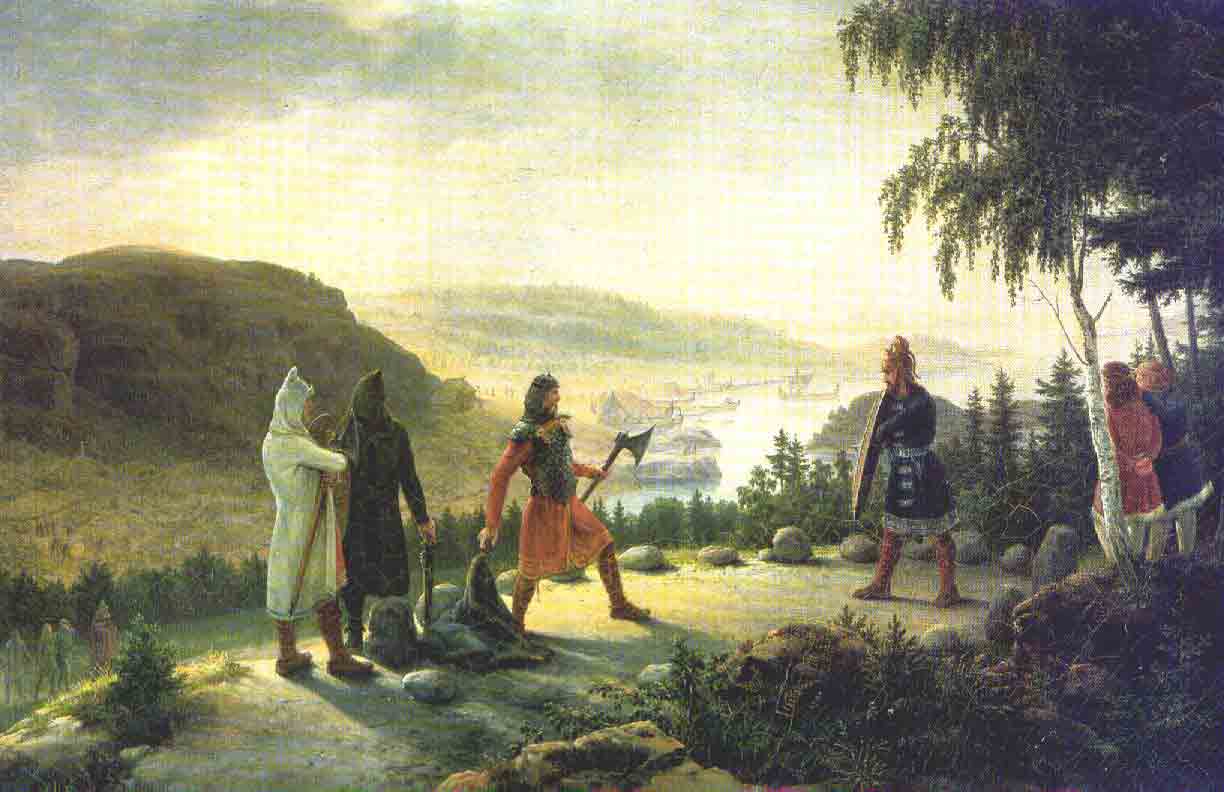
Wiglaf’s speech in praise of Beowulf — I can’t identify the artist.
If you’re going to get any edition of Beowulf, the ancient Anglo-Saxon epic, get this one. Until now, I got along with the serviceable translation by Michael Alexander — nothing wrong with it. But this translation by renowned Irish poet Seamus Heaney leaps from the page and sings. For the first time, a modern reader can experience the poem with the immediate pleasure that they would get from reading a good-quality contemporary fantasy novel.
Take this sample, chosen almost at random (I could have grabbed something from any page).
Here’s the original:
Nis þæt feor heonon
mīl-gemearces, þæt se mere standeð
ofer þæm hongiað hrinde bearwas;
wudu wyrtum fæst wæter oferhelmað.
Þær mæg nihta gehwæm nīð-wundor sēon,
fyr on flōde; nō þæs frōd leofað
gumena bearna þæt þone grund wite.
Heaney renders it:
A few miles from here
a frost-stiffened wood waits and keeps watch
above a mere; the overhanging bank
is a maze of tree-roots mirrored in its surface.
At night there, something uncanny happens:
the water burns. And the mere bottom
has never been sounded by the sons of men.
The English of a thousand years ago is so extremely different from the modern language that its ancient literature is inaccessible to us, except in translation. Many bored students have been flogged through Beowulf as an onerous duty, but otherwise the poem has not really excited the imagination of modern readers. This wonderful translation will change that. It has already become one of the most surprising bestsellers on the NYTimes list. I have to thank Skye Sepp for loaning me a copy. The paperback, published by W.W.Norton, is handsome. Heaney’s detailed preface is illuminating. I also have to thank Steve Muhlberger for drawing my attention to it on his site, Muhlberger’s Early History.
15353. (Stephen Grey) Ghost Plane ― The True Story of the CIA Torture Program
This is the essential book on the subject, which is too depressing for me go into in detail. If you have the stomach to learn just how profoundly evil the current administration in the United States is, and the disgusting Conservative movement that created it, then read this book. Until this issue is resolved, preferably by trying George W. Bush and his gangster chums for treason, Americans will never be able to look anyone straight in the eye.
15350. (Timothy Kyger) The International Space Station (ISS): Past, Present, and Future — A Critique [article]
If, like me, you’ve been confused by NASA’s constantly shifting plans for a space station, this brief article will clear up the fog. Those of us who grew up wanting to see a sustained and logical program of space exploration, not for immediate political and social motives, but for the long-term benefit of the human race, have always experienced some frustration with NASA. It’s as if we were genuinely religious people who discovered that their church was more interested in promoting bingo and church bazaars than in serving god. Tim’s paper provides many details that explain why manned space exploration has had such a lurching, unsatisfactory progress. Unmanned space exploration, by comparison, has a history of relatively smooth, logical progression. Hopefully, Tim will write another paper to explain why this is so.
15349. (Lawrence H. Keeley) War Before Civilization
I recommend this study of warfare in prehistoric societies, based on archaeological work and comparisons with anthropological studies of non-state (tribal and hunter-gatherer) societies. When Keeley began his work, his field was dominated by a kind of “neo-Rousseau-an” orthodoxy that in prehistoric societies without centralized states, warfare was unimportant, trivial in its effects, and, if extant, more ritual than in earnest. This orthodoxy was not based on anything more substantial than wishful thinking. Even when it held sway, the weight of archaelogical and anthropological evidence contradicted it. But it was so strong a notion that Keeley could not get a grant to study prehistoric fortresses, with clearly evident moats, pallisades, and skeletons of battle victims, until he renamed them “enclosures”.
FIFTH MEDITATION ON DEMOCRACY (written Monday, November 5, 2007)
It’s my contention that both hierarchical and egalitarian behaviour are equally “natural” to human beings. These two methods of interacting with others in a group have co-existed in all human societies, from the earliest stages of our evolution as a species. It is also my contention that, while there is a limited place for hierarchical thinking and behaviour in a good society, it is egalitarian thinking that has created civilization and morality. Any society that is dominated by hierarchy is essentially backward, self-destructive, and immoral. Read more »
Christos Hatzis “Constantinople”
For my eighteen-thousandth first listening, I wanted to pick something at least a little special, so I chose Christos Hatzis’ 90-minute work for soprano, middle-eastern vocalist, piano trio, and digital audio. When I listened to it, my reaction was “wow” ― not a word that comes up very often, considering my jaded listening experience.
About five (maybe six) years ago, I heard a fragment of music over the radio that struck me as very beautiful. It was clearly a modern piece, but unlike most of the mildly interesting, but bloodless items ground out by the conservatory crowd, it was suffused with intense emotion. Technically, it could have been by any of the eclectic composers of today, but emotionally, it could have been by Rachmaninov! Whatever it was, it was profoundly moving. But I was interrupted, and didn’t learn what it was or who composed it. Two years ago, I heard another piece, very similar, performed by the Gryphon Trio. It was labeled “Old Photographs”, by the Toronto composer Christos Hatzis. I liked this almost as much as the first, and it was clearly connected to the mystery piece I had heard before, part of a suite or something. I subsequently found a number of his choral pieces, all of them enjoyable. Read more »
(Hitchcock 1953) I Confess
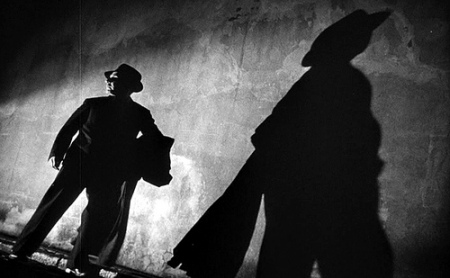
 If you’re looking for a good Hitchcock film that isn’t constantly screened, then check out this 1953 item which failed at the box-office, but contains all the elements of classic Hitchcock. Montgomery Clift gives one of his typically tense and repressed performances as a priest falsely accused of a murder. The setting, Quebec City in the early 1950’s, is represented with more realism than Hollywood usually managed with such “exotic” locales at that time. The main hook, that the priest can’t clear himself because the real murderer has confessed to him under the “seal of the confessional”, might be a stumbling block for today’s audience, but given that understanding, the plot works out logically. The heroine, played by Anne Baxter, comes across as a thoroughly dislikable person, which may have been the main reason the film failed with the public. By the end of the first reel, I was hoping that she would turn out to be the real murderer. Karl Malden gives an odd performance, obviously uncertain how to represent a French Canadian police detective, and uncomfortable with his stilted dialog.