17668. (Albert Roussel) Symphony #2, Op.23
17669. (Albert Roussel) Symphony #4, Op.53
Rough Guide to the Music of Thailand:
. . . . 17670. (Man Motorgai) “Hae Nang Maew”
. . . . 17671. (Namoiy Thammalangka) “Lam Yai Lam Poon”
. . . . 17672. (Surasak Donchai) “Phin Solo ‘Transcendental Technique’ ”
. . . . 17673. (Mike Piromporn) “Lerk Dai Lerm Bor Dai”
. . . . 17674. (Siriporn Aumpiapong) “Rang Jai Rai Wan”
Read more »
First-time listening for October, 2007
Posted by Phil Paine
on October 31, 2007
No comments
READING – OCTOBER 2007
Posted by Phil Paine
on October 31, 2007
No comments
15347. (Adjutor Rivard) Chez Nous, Our Old Quebec Home [tr. W.H. Blake, ill.A.Y. Jackson]
15348. (Jean Pierre Waltzing) Étude historique sur les corporations professionnelles chez
. . . . . les Romains, vol.1
(Nelly Hanna –ed.) Money, Land and Trade: An Economic History of the Muslim
. Mediterranean:
. . . . 15349. (Nelly Hanna) Introduction [preface]
. . . . 15350. (Nicolas Michel) The Individual and the Collectivity in the Agricultural
. . . . . . . . Economy of Pre-Colonial Morocco [article]
Read more »
Oscar Peterson Plays Duke Ellington
Posted by Phil Paine
on October 29, 2007
No comments
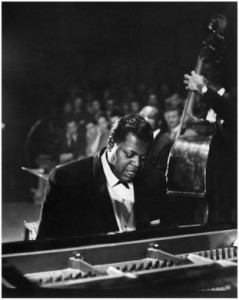 It took me a long time to get into Oscar Peterson. His compositions seem, at first, to be casual little puffs, dashed off effortlessly. This is an illusion. As you let them sink in, you realize what incredible precision, control, and subtlety they have. Peterson is as cool as a plate of sliced cucumbers served on a bed of freshly fallen snow, but there is an emotional power behind it. The precision itself becomes an emotional statement: this is exactly how things should be, this is where this note belongs, this is the precise one hundredth of a second it should be struck.… see! Not for everyone, but for those who feel it, it’s ambrosia.
Peterson is without contest Canada’s jazz giant, the man who speaks for us. Duke Ellington is just as deeply American. Their jazz pantheon is so huge that he can’t claim unchallenged primacy, but surely he’s among the greatest American jazzmen. Like Peterson, Ellington was a perfectionist, a man who planned every note, a classicist at heart. He didn’t much resemble the troubled, erratic geniuses that people associate with jazz. His brilliance was so obvious that nothing could keep his compositions out of the symphonic repertoire, even in the 1920s. Ellington had a stronger, louder voice than you hear in Peterson’s delicate, contemplative compositions. So is there a conflict? Hardly. Playing Ellington seems to have allowed Peterson to cut loose. You hear another Peterson, sassier than when he played his own stuff. I love this record.
15420. (G. P. Singh) Republics, Kingdoms, Towns and Cities in Ancient India
Posted by Phil Paine
on October 26, 2007
No comments
The above three titles are essential reading for anyone interested in the history of democracy. When Steve Muhlberger and I wrote Democracy’s Place In World History, Majumdar (written in 1918) and Altekar (written in 1949) were important sources for us. The first book alerted us to the significance of the ancient Indian republics, which had become an unfashionable area of study, and were little known to historians outside India. The second provided a serious analysis of them, and demonstrated conclusively that they had to be taken just as seriously as the political institutions of ancient Athens. Ancient India was home to many hundreds of city-states, territorial states, leagues, and confederacies, and many of these were democratic, or proto-democratic, in the same sense as the polities of Greece. They involved far greater populations, were contemporary with the Greeks, outlasted them, and probably preceded them. Greek travelers had no difficulty seeing their close resemblance to their own.
It has been very gratifying to see that our little essay has contributed to a renewed interest in this subject. G.P. Singh’s 2003 book is an example of the renewal of scholarly attention. It’s a comprehensive survey of the existing documentary evidence, with something on every location that can be connected to proto-democratic, oligrachic, or conciliar institutions. This background knowledge is essential if any analysis is to take place, and Singh provides up-to-date information on these sources. It by no means replaces Altekar’s State and Government in Ancient India, which attempts more analysis and interpretation of the data. Altekar’s analysis, in my opinion, usually hits the mark. His reconstruction rings true.
Another book that was an important source for us was J.P. Sharma’s Republics in Ancient India c. 1500BC-500BC, but I haven’t reread it (I intend to). So if you have any interest in the republics of ancient India, start with these four books.
Tagaq: Sinaa
Posted by Phil Paine
on October 23, 2007
No comments
 Tanya Gillis Tagak is a young singer from Ikaluktuutiak (Cambridge Bay), in Nunavut. She learned traditional Innuit throat singing at the age of fifteen, but quickly moved to develop an “avant-guarde” style of solo throat singing. Comments that she is the Björk of the Arctic are well deserved. She collaborated with Björk on the 2004 album Medúlla, and toured with her. The duet from that album, “Ancestors”, appears on Sinaa(2005), her first complete studio album. It had a tremendous impact in Canada’s aboriginal cirlces. She has performed with the Kronos Quartet and the eclectic Scottish band Shooglenifty. Like Björk, Tagaq is relentlessly experimental. The casual listener, however, who hasn’t been raised with Innuit throat singing may not be able to distinguish what is traditional from what is innovation.
Wednesday, October 17, 2007 — Some Thoughts On Burma
Posted by Phil Paine
on October 17, 2007
No comments

Neighbourhood in Yangon, Burma — Burma (also called Myanmar) is considered one the most economically mismanaged countries on earth.
The greatest shame and degradation for human beings is to be ruled by an aristocracy. Whether one is reduced to abject slavery, or merely forced to submit to graded snobberies and unearned privilege, it all comes down to the same truth. Aristocratic government is a violation of fundamental morality, and an intolerable insult to human dignity. It follows that the heroes of our species are those who defy, resist, and overthrow aristocracy, and strive for the only morally acceptable arrangement of human politics: democracy. It also follows that those who seek to impose or preserve dictatorship over human beings are the palpable villains. And as for those who stand by while others risk their lives for freedom, encourage their oppressors, and rush to trade and socialize with the tyrants ― well, no language is vivid enough to describe their cowardice and treachery.
It’s not hard to pinpoint who are the current heroes and villains. Read more »
15370. (Orhan Pamuk) The White Castle
Posted by Phil Paine
on October 11, 2007
No comments
Nobel Prize winner Orhan Pamuk is the leading light of modern Turkish fiction writing. This is one of his early novels. It’s extremely well-crafted, and its qualities come through in what must be a very good translation by Victoria Holbrook. It’s a short novel, dealing with a simple theme, without the pretensions and convolutions that are thought obligatory by current fashion. It’s set in the late 18th Century, and narrated by an Italian who becomes the slave of an Ottoman scholar, to whom he bears an uncanny physical resemblance. With knowledge of each others’ most intimate secrets, they become able to exchange identities. Evliya Chelebi, the great 18th Century Turkish polymath, makes a cameo appearance, and so does a character, unnamed, whom I suspect is meant to be Giovanni Paolo Marana, an Italian author whom I discuss in my Third Meditation On Democracy.
Holy Barbarians: Cream
Posted by Phil Paine
on October 9, 2007
No comments
If I were to pick one band to illustrate the convoluted rock trends of the 1980’s, it would be The Cult. This notoriously fractious, unpredictable, and peripatetic band usually hovered somewhere in between the Doors and AC/DCin its overall sound, but ventured into all sorts of other moods. Despite their notorious internal bickering and temporary split-ups, they have managed to remain a force in rock for a quarter century. Anyone with a serious rock collection is likely to own copies of Love (my own favourite) and Sonic Temple. Their Canadian tour last year still pulled in huge crowds, especially here in Toronto.During one of their temporary split-ups, lead singer Ian Astbury started up a garage band called Holy Barbarians, which recorded only this one album, in 1999. Creamis a decent album, worth playing now and then, but it illustrates how much The Cult benefited from the fine guitar playing of Billy Duffy. Without him to balance Astbury, the singer often comes across too heavy-handed. Some of the songs seem stagy and melodramatic. But “Opium” is first rate, and “Brother Fights” is quite good, too. If you are a Cult fan, pick up this album, not only for the sake of completeness, but to show, by contrast, just how the combination of Duffy and Astbury worked.
(Krishna 1991) Masala; (Mehta 2002) Bollywood / Hollywood
Posted by Phil Paine
on October 5, 2007
No comments
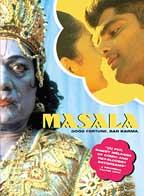
Masala (1991)
Both these films, made eleven years apart, are surrealistic comedies about Indo-Canadian families in Toronto. I first saw Masalawith a roomful of friends, some of South Asian background, some not, but all Canadians raised in Toronto. I think we all enjoyed it more for its “Toronto-ness” than for anything as dourly serious as “identity politics”. It had the feel of our city, and the same goofiness that you would see in Strange Brew. Seeing the venerable Saeed Jaffrey as the God Krishna in a Leaf’s goalie uniform had us rolling on the floor with laughter. And the same actor portrays the long-suffering postal clerk, to whom Lord Krishna delivers the rarest Canadian stamp, but who is unwilling to sell it either to satisfy his wife’s craving for appliances, or the government’s pressure, and is the Canadian Everyman in a nutshell. Read more »
15347. (Adjutor Rivard) Chez Nous, Our Old Quebec Home [tr. W. H. Blake, ill. A. Y. Jackson]
Posted by Phil Paine
on October 4, 2007
No comments
This was another delightful find in the Goodwill book bins. Rivard’s 1914 memoir of life in late nineteenth century rural Quebec was once well-known, even in Europe. Rivard was admitted to l’ Académie françaiseon the strength of it. Yet it was written in the full-blooded, earthy Canadian language, rife with archaic Norman and Celtic influence (A delegation from the Scottish Parliament, this year, was bouleverséwhen accosted by a platoon of francophones from rural Quebec sporting kilts, sporans and bagpipes). Rivard was an accomplished philologist, and like Mark Twain, a meticulous observer of dialect. This English translation sort of suggests it, but it can’t put across the peculiar feeling of “la bordée de ce soir a presque abrié les balises”, or “c’est matin pour les lièvres”, any more than a translator can render the feeling of Huck Finn’s speeches into Latin. But this translator is conscientious, and does a pretty good job.
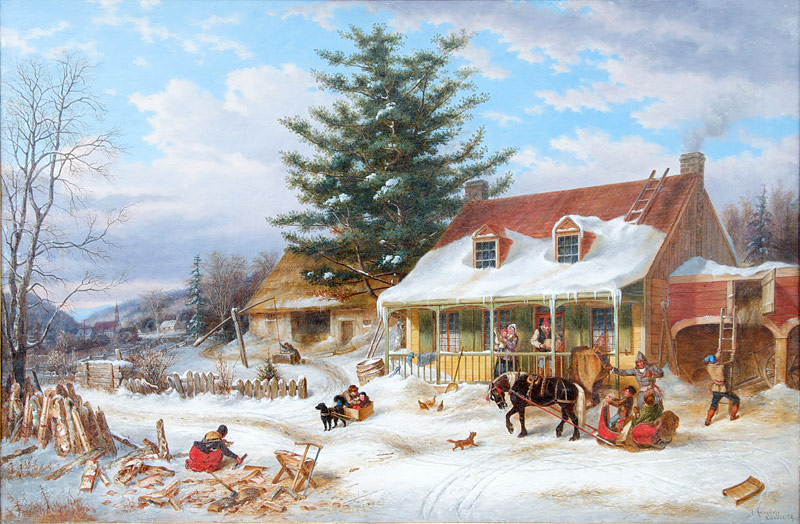
Cornelius Krieghoff “Early Canadian Homestead” (1859)