 Most of these stories, written between 1948 and 1955, have worn out with time. The title story, for instance, is a parable to teach racial tolerance that now just seems corny, though I’m sure it had an impact when it was written. But the second last story, “Dear Devil” still holds up well. I read it when I was a child, got intense pleasure from it, and never forgot its details. It takes place on an Earth long after a nuclear war, where a few humans struggle to survive. An alien poet, who is stranded on Earth, befriends a human boy, and helps him find hope and meaning in life. Russell rose above his usual pulp style to write this, and the emotional ending is superb. You can see this story as the principle inspiration for Edgar Pangborn’s later A Mirror For Observers(1954) and Davy(1964), which employ some of the same elements, and have the same mood and attitude. There is also some resemblence to George R. Stuart’s Earth Abides, published a year before. All these stories share the same concerns, and the same humanistic impulse to find some sort of balance between youth and age, freedom and responsibility, cynicism and hope. “Dear Devil” was often anthologized, so if you can’t find this old Ace collection of Russell’s work, you should be able to dig it up in some thematic or “best of” anthology. Make the effort. Read more »
(Eric Frank Russell) Somewhere, A Voice [collection]
(Sweete 2002) Timothy Findlay’s Elizabeth Rex [tv play; w. Diane D’Aquila, Peter Hutt, Brent Carver]
Timothy Findley (1930–2002) was one of Canada’s finest novelists, but he began as an actor before turning to writing. He was part of the original Stratford Festival company in the 1950s, acting alongside Alec Guinness. His lifetime partner, William Whitehead, his inseperable other half from 1951 until his death, was an actor and director, responsible, among other things, for over a hundred episodes of the groundbreaking science series The Nature of Things, and the extremely intelligent radio series Ideas. They occasionally collaborated on screenplays. So it should come as no surprise that Findley wrote a fine play, as well as familiar novels like The Warsand The Last of the Crazy People. Read more »

FILMS OCTOBER-DECEMBER 2006
(Armstrong 1999) MidSomer Murders: Ep.9 — Blood Will Out
(L’Ecuyer 2004) Prom Queen
(Gaudreault 2003) Mambo Italiano
(Asquith 1952) The Importance of Being Earnest
(Ratushniak 2004) Iron Men, Wooden Ladders
(Hitchcock 1955) To Catch a Thief
(Asquith 1948) The Winslow Boy
Read more »
First-time listening for December, 2006
16832. (John Taverner) Kyrie “Leroy”, for 4 voices
16833. (John Taverner) Missa Gloria Tibi Trinitatis for 6 voices
16834. (John Taverner) Dum transisset sabbatum (i), motet for 5 voices
16835. (Weather Report) I Sing the Body Electric
16836. (Ferrante & Teicher) Moonlight Melodies
16837. (Heitor Villa-Lobos) Bachianas Brazileira #1 for Eight Cellos
16838. (Heitor Villa-Lobos) Suite for Voice and Violin
16839. (Heitor Villa-Lobos) Preludes and Fugues from Bach’s “48” for Orchestra of Cellos
16840. (Franz Josef Haydn) String Quartet in B‑flat, Op.71 #1
Read more »
READING – DECEMBER 2006
14856. (Robert Smith Thompson) Empires On the Pacific ― World War II and the Struggle for
. . . . . the Mastery of Asia
14857. (F. Kaid Benfield, Matthew D. Raimi & Donald D. T. Chen) Once There Were Greenfields
. . . . . ― How Urban Sprawl Is Undermining America’s Environment, Economy and Social Fabric
14858. (Andre Dubus III) House of Sand and Fog
14859. (Mary Frances Cusack) An Illustrated History of Ireland From AD 400 to !800
14860. (Nicholas Meyer) The Seven-Percent Solution
14861. (Ian Finlay) Columba
Read more »
Haider Ali
 Haider Ali (or Ali Haider, علی حیدر ) is probably the most popular light pop singer to come out of Pakistan. His seven albums will be hard for a Canadian to accumulate, but it is easy to find the two Best of Haider Alidiscs, which I have. He is not as much of a light-weight as you might guess. Yes, the arrangements are pure pop, but he chooses melodies that have some folkloric roots, and his performances are flawless. There is also noticeable development. He finds his feet with the fourth album, Qarar. This contained the hit “Purani Jeans”, which I’m told found a cross-generational audience. After this, the songs became subtler, and better crafted, with touches of classical Urdu style embedded in the euro-pop orchestration. Some of the later songs have live flute, tabla, dholak, sitar and banjo. “Papa Mumi”, a hit from his best-regarded fifth album Dastaan, is more than just a pop song, and it comes across emotionally to someone like me, who doesn’t understand Urdu.
Thursday, December 21, 2006 — Thinking of Fish
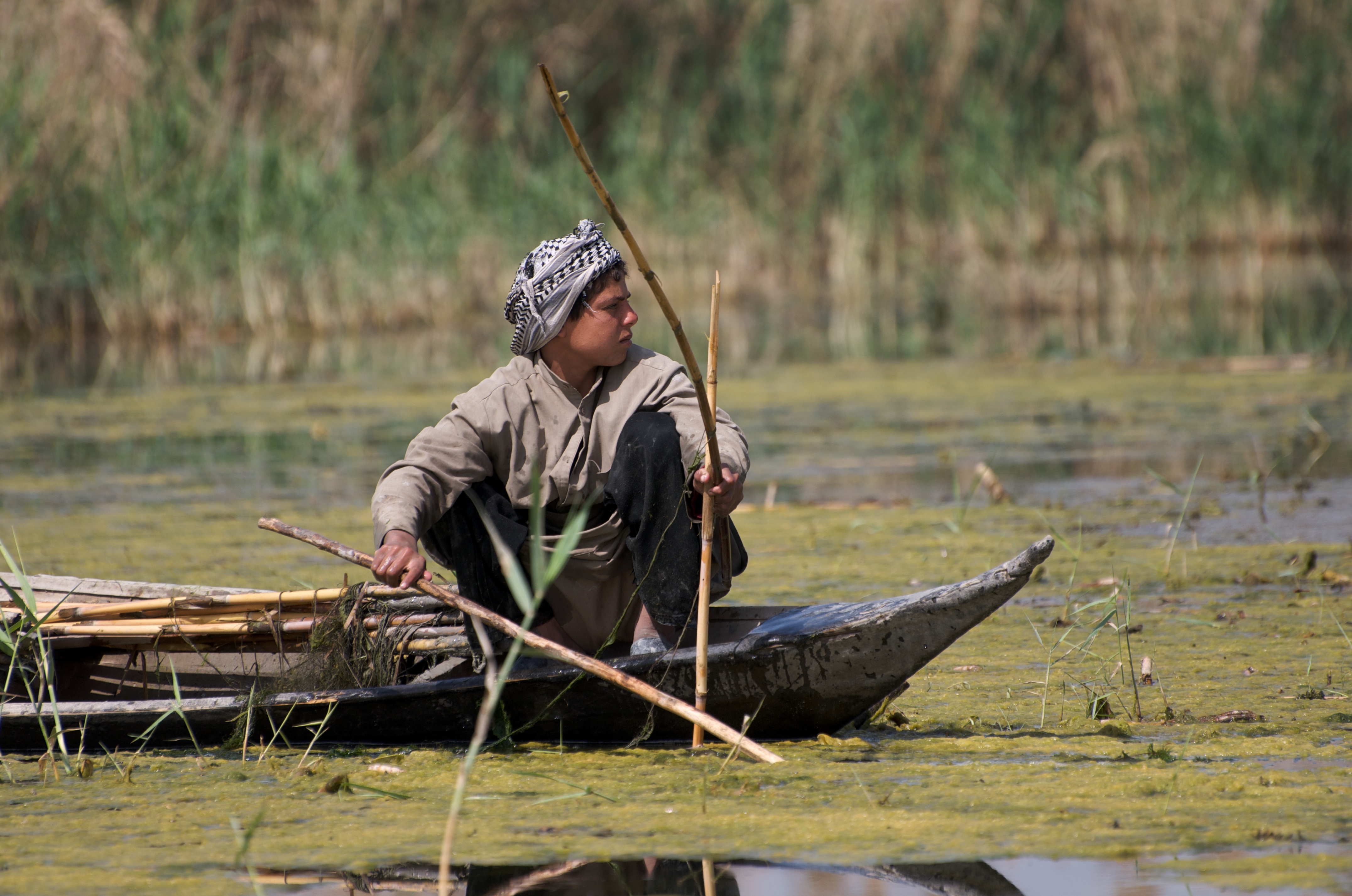
A young Marsh Arab. The عرب الأهوار (ʻArab al-Ahwār) “Arabs of the marshes” live in the extensive delta of the Tigris and Euphrates in Iraq. Their traditional lifestyle, based on fishing, is strikingly similar to that of the ancient Sumerians.
There is finally starting to be some reporting in the media on an issue of supreme importance: the oceans are being destroyed at a spectacular rate. This disaster is every bit as serious as the problem of climate alteration, to which it is connected. It is a hundred times more serious a problem than terrorism. You will notice that I have not phrased the issue in the nebulous, blame-evaporating way that has become customary. I have not said that “we” are destroying the oceans. We are not doing this. It is being done by specific people: the gangsters of the world’s dictatorships, the elected decision-makers in corrupted and half-functioning democracies, and a host of corporate criminals. The corporate powers are not separable from government. All corporate power is in some way a manifestation of government power. The presidential Bush family, for instance, is among the oligarchs that have accumulated fortunes through devastating the seas. A small number of people, who certainly have no legitimate claim to these natural resources, grow wealthy. In the process, they are rapidly destroying something that is essential for our survival. Read more »
Sunday, December 10, 2006 — Another Cockroach Dead
Fidel Castro still lives, but there was some good news today. Another disgusting cockroach that has infested our world has died. No sane person will miss Augusto José Ramón Pinochet Ugarte, the ruthless dictator of Chile. The tragedy is, of course, that Pinochet was never brought to justice, never truly defeated by the forces of civilization and liberty. He was merely demoted, and some of his toys were taken from him. The countless thousands whom he tortured and murdered, the millions he exploited, have seen no justice. The same will be for Castro. Pinochet and Castro were, of course, identical twin brothers, duplicates of each other down to the smallest molecule. Both have gotten away with it. They have lived to ripe old ages, unrepentant and unpunished for their crimes.
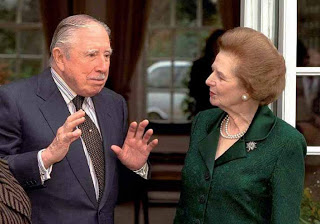
Britain’s Margaret Thatcher chats amiably with dictator, mass murderer and torturer Augusto Pinochet, whom she seems to have deeply admired. At the time of this photo, Pinochet was under indictment for a tiny portion of his atrocities
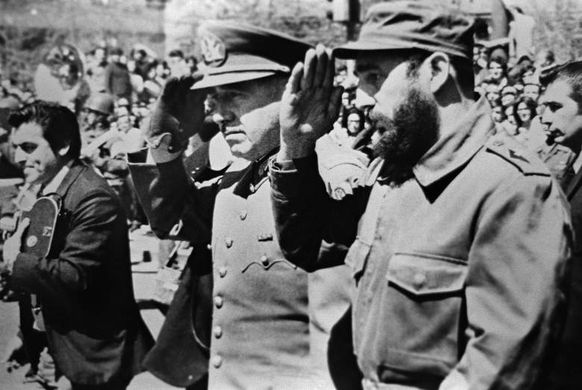
Augusto Pinochet and Fidel Castro in 1971, celebrating the acme of Pinochet’s torture regime.
¿Que diferencia tienen estos dos dictadores? — Nada.
Thursday, December 7, 2006 — Impressions of Stéphane Dion
I watched the Liberal Party’s national leadership convention with great interest, because the current Conservative government is rapidly losing the respect of the Canadian people, and the Liberals have a very good chance of winning the next election. The convention opened with Michael Ignatieff as the favourite, with a strong lead.
Ignatieff comes from an unusually prestigious background for a Canadian politician. His grandmother was Princess Natasha Mestchersky and his grandfather was Count Paul Ignatieff, a close advisor to Czar Nicholas II serving as his last Minister of Education. In 1918, Count Ignatieff was arrested and slated for execution but fled to Canada with his family after he was released by sympathetic guards. His father was a career diplomat who served as representative to NATO (1963–1966), Canadian Ambassador to the United Nations (1966–1969) and president of the United Nations Security Council. Read more »