16911. (Wolfgang Amadeus Mozart) Thamos, König in Ägypten, K.345 [336a] [d. Harnoncourt;
. . . . . w. Thomaschke, Perry, Mühle, Altena, van der Kamp]
16912. (Martha Wainwright) Martha Wainwright
Mojo Chess Northern Soul:
. . . . 16913. (Marlena Shaw) “Let’s Wade in the Water”
. . . . 16914. (Mamie Galore) “It Ain’t Necessarily So”
. . . . 16915. (Radiants) “Hold On”
. . . . 16916. (Dells) “Wear It On Our Face”
Read more »
First-time listening for January, 2007
Posted by Phil Paine
on January 31, 2007
No comments
READING – JANUARY 2007
Posted by Phil Paine
on January 31, 2007
No comments
(Eric Frank Russell) Somewhere, A Voice [collection]
. . . . 14900. [2] (Eric Frank Russell) Somewhere A Voice [story]
. . . . 14901. [2] (Eric Frank Russell) U‑Turn [story]
. . . . 14902. [2] (Eric Frank Russell) Seat of Oblivion [story]
. . . . 14903. [2] (Eric Frank Russell) Tieline [story]
. . . . 14904. [2] (Eric Frank Russell) Displaced Person [story]
. . . . 14905. [2] (Eric Frank Russell) Dear Devil [story]
. . . . 14906. [2] (Eric Frank Russell) I Am Nothing [story]
14907. (Donald W. Clarke) Prehistory of Great Bear Lake [article]
14908. (Roger Bacon) The Opus majusof Roger Bacon, edited with introd. and analytical table by
. . . . . John Henry Bridges
14909. (Roger Bacon) Part of the Opus tertiumof Roger Bacon, including a fragment now printed for
. . . . . the first time
Read more »
Songs of Mukanda : music of the secret society of the Luvale people of Central Africa
Posted by Phil Paine
on January 23, 2007
No comments
This is an anthropological collection songs and music which take place during the initiation/seclusion period (mukanda) of Luvale boys of Zambia. Most Luvale art is in the form of masks, many of which are danced with, during ceremonies to educate the initiates and to mark the territory where the ceremonies take place. The Luvale (who also live in Angola, where they are called Lwena) peoples are closely related to the Chokwe, and their history is interconnected with both Chokwe and Lunda political movements, which have historically dominated the region. They number about 20,000. The agrarian Luvale grow manioc, cassava, yams, peanuts, tobacco, hemp and maize (grown to make beer). They keep some sheep, goats, pigs, and chickens, but prestige meats are wild game provided by a restricted secret society of hunters. The Luvale are divided into two categories, those who are descended from the founding matrilineal lines and those who are descended from former enslaved populations. The society is governed by family headmen who owe tenuous allegiance to local chiefs who inherit their positions matrilineally from the maternal uncle. The chiefs (mwana nganga) consult with a committee of elders and ritual specialists before making decisions. The Luvale preserve traditional religion, based on Kalunga, a god of creation, and a series of nature and ancestral spirits. The music in the collection is chiefly of interest to anthropologists and African musicologists, but some of the songs might entertain a casual listener.
14924. (Brian Sloan) Tale of Two Summers
Posted by Phil Paine
on January 21, 2007
No comments
I was deeply impressed by the courage and skill that went into this new novel for teenagers. First of all, it undertakes the technically difficult task of writing a novel in the style of a blog, with current teenage blog-language used convincingly. Second, it gets in the head of two teenagers, one straight and one gay, who have maintained a friendship from childhood, and are confronting their first sexual choices. Sloan, who is a film director, succeeds admirably in both these tasks. I have been told by too many people that the current atmosphere in publishing precludes an intelligent treatment of teenage sexuality. This book proves that those people are wrong. Yes, it’s true that the marching morons have commandeered and corrupted much of the media in North America. Yes, it’s true that an aging population in the United States and Canada has been getting steadily stupider and more conservative. But it is essential that writers resist these trends, and stand up for true moral values against the ignorance and immorality of Conservatism, especially when it comes to writing for the young. Sloan does so, and earns my respect for it.
Friday, January 19, 2007 — Schools for Democracy
Posted by Phil Paine
on January 19, 2007
No comments
We have all complained about the lack of decent candidates to vote for, in elections. Yet nothing compels us to constantly elect sleazy and incompetent people to public office. Every community has talented, honourable, and uncorruptible people. It is the structure and customary operation of political parties that ensure that such people never enter politics.
So what is the solution for people who want to see reform and progress in their communities (whether local, regional, or national)? I think the solution is a school. What if there was a School of Democratic Public Service? It’s purpose would be to prepare people to run for public office. We expect someone who runs a hydro-electric plant to study civil engineering, we expect a carpenter to study carpentry. Why should we not expect anyone who presents themself as a candidate for political office to have studied it? This is not the same thing as studying “Political Science”. We would expect a serious candidate for public office to study philosophy, economics, management, environmental science, urbanology, history, sociology, law, human rights and moral philosophy, among other things, specifically as they relate to holding public office. If there was a school which offered a degree of Master of Democratic Public Service, and its courses where observably rigorous and progressive, I would certainly look on any independent candidate who held that degree with enough respect to consider voting for them. If any party went out of its way to select candidates who held such degrees, I would be inclined to take its platform seriously. I would be even more inclined to vote for someone who could demonstrate that they did not enter politics from business, or law practices that obviously incline them to bend to special interests or to seek financial gain through their office. Read more »
14919. (Brian Clegg) The First Scientist, A Life of Roger Bacon
Posted by Phil Paine
on January 16, 2007
No comments
 This rounds off a little project of mine to investigate Roger Bacon, the thirteenth century Franciscan friar who wrote about the possibilities of scientific inquiry. His work was suppressed in his lifetime, and he spent most of it imprisoned by his religious order, and forced to bribe his keepers to smuggle in writing paper. His large (for the time) collection of books and experimental apparatus disappeared in the turmoil of war. Since then, his reputation has suffered extremes of interpretation. Renaissance popular culture saw him as an occultist and magician. It was claimed, among other absurdities, that he possessed a talking head of brass. His unrelated namesake, Francis Bacon, expropriated many of his ideas and received the credit for them. Some nineteenth century historians praised him, struck by his prophetic assertions that inquiry into nature would make it possible to observe the stars and very small things with properly arranged lenses, that we would some day create flying machines and “cars” that move without the help of animals, that we would be able to record and replay sounds, and for his precise chemical formula for gunpowder. But twentieth century historians tended to downgrade him to a “pre-scientific” curiosity. Read more »
Sidney Bechet
Posted by Phil Paine
on January 13, 2007
No comments
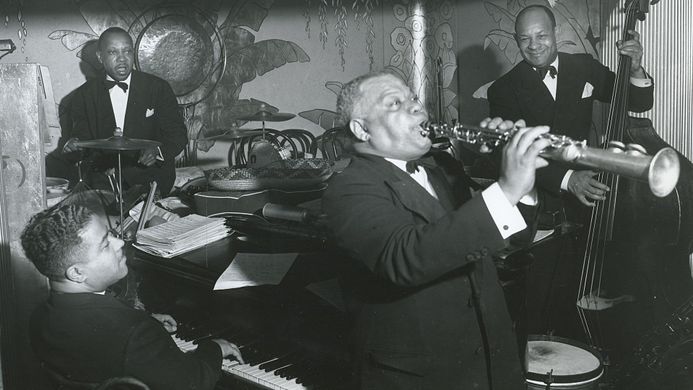 Everest Records’ Archive series gives me a selection of fine New Orleans tunes by one of the most versatile of early jazzmen. Bechet (1897–1959) played many instruments, but was best known on soprano sax, clarinet, and cornet. He was a prodigy, discovered at the age of eight by Freddy Keppard, and employed in Keppard’s band at eleven. Greatly admired as a highly creative and individual performer by other jazzmen (notably Duke Ellington), Bechet was a cultured and poetic man, who divided his time between Europe and America, and after WW2, married and ended his days in France. It’s said that he was the model for the character “Pablo” in Hermann Hesse’s Steppenwolf. This is quite possible. In 1929, he appeared with his own band at the Haus Vaterland café in Berlin, where Hesse could easily have seen him. Some of the cuts on this disk feature Lionel Hampton, and Bechet’s powerful vibrato is deliciously echoed by his vibes. The Everest vinyl is probably hard to find, but there’s a good cd collection called The Legendary Sidney Bechet, which includes his performances with the New Orleans Feetwarmers, Tommy Ladnier, Jelly Roll Morton, and Dr. Henry Levine.
Monday, January 8, 2007 — Karen Refugees in Canada
Posted by Phil Paine
on January 8, 2007
No comments
 The CBC (Canadian Broadcasting Corporation) often does excellent international reportage, especially when they deploy correspondents like Patrick Brown. Tonight’s National News featured a good example. For decades, the dictatorship in Burma has been committing systematic mass murder while suppressing the seven-million strong Karen ethnic group, and using many they don’t kill for slave labour. Brown entered Burma (Myanmar) through the jungles of the Thai border with young Karen who are determined to document conditions in that region with handicams. Brown carefully gave a rundown of the historical background, introduced the main elements of Karen culture, and interviewed several people. Most dramatic was the interview with a frail, elderly woman forced to build roads for the Burmese army — roads which will be used to bring in troops to mine the region and burn down Karen villages. Read more »
Sunday, January 7, 2007 — Who Will Undertake These Tasks?
Posted by Phil Paine
on January 7, 2007
No comments
As we enter the seventh year of a new millennium, the saddest thing to contemplate is not only the problems we face, but the pathetic inadequacy of the intellectual tools employed to address them. There has been, in effect, no progress in the way human social, political and economic issues are discussed. It is as if we were attempting to practice modern medicine, but incapable of employing any terminology except the prescientific concepts of “humours”, divine retribution, witchcraft and astrology. That is surely the state of affairs, for instance, when the idiotic “left/right” template is employed to describe “the political spectrum”, or when the childish pseudo-intellectual superstitions of Marxism and Conservatism still provide the frame of reference. These concepts were worthless when they emerged and petrified two centuries ago. That they remain dominant, unchanged, and inescapable in their putrescence, after all this time, suggests that our politicians, journalists, academics, and pundits are not capable of reasoning, learning, or growing up. Read more »
Joe Zawinul
Posted by Phil Paine
on January 5, 2007
No comments
Jazz pianist and composer Josef Erich Zawinul first came into prominence as the founder of the band Weather Report, which I will consider separately. He’s been a major figure in jazz since then. Though he emigrated to the United States from his native Austria as a young man, he always retained strong European roots, emotionally as well as musically, and eventually returned to Austria. My focus here is on two of his solo albums, Zawinul(1970) and Stories of the Danube(1995).
Despite the eponymous title, the first one is essentially a collaboration of Zawinul and Herbie Hancock. It’s an early example of the fusion movement that swept Jazz in the seventies, with Miles Davis, Zawinul and Hancock at the forefront. The Rhodes piano-echoplex-ring modulator combo of this album was soon to be superseded by synthesizers. The jazz conventions are still there, but Zawinul is mostly interested in creating ambient soundscapes, and the feeling is not spontaneous. In fact, it’s hard to get emotionally involved with this music. Only the first cut, the long piece called “Doctor Honoris Causa”, is satisfying. Woody Shaw participates on this piece, to good effect. The second cut, “In a Silent Way”, is particularly disappointing, because Miles Davis did a much better job covering it, later on. The rest is rather dry. Twenty-five years later, there is not much jazz left in Stories of the Danube, which is a symphonic suite enlivened by fragmentary whiffs of jazz and middle eastern dance music. The melody of “Doctor Honoris” makes an appearance. It’s pretty much an updated version of Smetana’s Mauldau, using a bigger river and a less intimate palette. Most of it will give pleasure to the listener, especially since the movements grow more engaging towards the end. I wish I had more of his work in my collection, so I could trace out the evolution between these two albums.