
First-time listening for May, 2006
Posted by Phil Paine
on May 31, 2006
No comments
15668. (Franz Josef Haydn) Trio for Piano, Violin and Cello in F, H.XV:2
15669. (Franz Josef Haydn) Trio for Piano, Violin and Cello in B‑flat, H.XV:8
15670. (Franz Josef Haydn) Trio for Piano, Violin and Cello in F, H.XV:6
15671. (Finger Eleven) Finger Eleven
15672. (Franz Josef Haydn) Trio for Piano, Violin and Cello in D, H.XV:7
15673. (Franz Josef Haydn) Trio for Piano, Violin and Cello in A, H.XV:9
15674. (Franz Josef Haydn) Trio for Piano, Violin and Cello in E Minor, H.XV:12
15675. (Dmitri Shostakovich) Symphony #2, Op.14
Read more »
READING – MAY 2006
Posted by Phil Paine
on May 31, 2006
No comments
14657. (Dan O’ Neill) The Firecracker Boys
14658. [2] (William Shakespeare) Henry V [play]
(Groff Conklin –ed.) 5 Unearthly Visions:
. . . . 14659. (Eric Frank Russell) Legwork [story]
. . . . 14660. (Walter M. Miller, Jr.) Conditionally Human [story]
. . . . 14661. (Raymond Z. Gallun) Stamped Caution [story]
. . . . 14662. (Damon Knight) Dio [story]
. . . . 14663. (Clifford D. Simak) Shadow World [story]
14664. (Michel Tremblay) Quarante-quatre minutes, quarantes-quatre secondes
Read more »
14671. (Barbara Haworth-Attard) Theories of Relativity
Posted by Phil Paine
on May 29, 2006
No comments
This is a juvenile novel about a teenager living on the streets of an unidentified Canadian city. He is not, strictly speaking, a “runaway”, but the equally common “thrown away”, effectively kicked out of a disfunctional single-family home. Unlike most books of this sort, Haworth-Attard’s treatment is neither sentimental, nor preachy. This kind of street life is something I know well, and I can vouch for the accuracy of most of the details. I found only a few small improbabilities, and those subject to interpretation. The author has done her homework. As a story, it reads well. The characters are believable, and the use of Einstein as a leitmotif is deftly handled. In recent years, fiction aimed at teenage readers is being written at a very high level quality, especially in Canada. Ironically, one has to go to teenage fiction to find the honesty, serious subject matter, and emotional intensity that are vanishing from genre fiction aimed at adults.
Chubby Checker
Posted by Phil Paine
on May 26, 2006
No comments
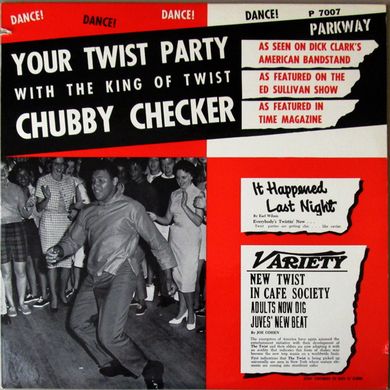 Ernest Evans (stage name “Chubby Checker”, a spoof of “Fats Domino”) is an example of a perfectly competent singer who might have had a long and highly respected career, if not for the fatal popularity of one hit tune. He is the only recording artist to have five albums in the Top 12 all at once. He is the only artist to have a song reach #1 twice, with the dreaded “Twist”. I am listening to that sad little item on the original Parkway album, Your Twist Party, in its 1961 Canadian pressing — a nice little rarity in my vinyl collection. “The Twist” was nothing but a little ditty that triggered a brief dance craze, but it branded Checker as the musical equivalent of hoola hoops, and he was never permitted to sing much of anything else again, and never taken seriously. This is the saddest aspect of show business. In some ways, utter failure offers some dignity. To be briefly worshiped for some lame, trivial accomplishment, then cast aside and mulched back into the earth must be utterly humiliating. Checker’s singing was quite stylish, and some of his performances of rock-and-roll and show standards on this album, such as “Ballin’ the Jack”, “Blueberry Hill” and even “I Could Have Danced All Night” show that he could have been a long-term success.
14668. (Martin Brauen) Dreamworld Tibet
Posted by Phil Paine
on May 25, 2006
No comments
Of all places in the world, Tibet has attracted the most fantastic mystification. Martin Brauen’s book is a study of the bizarre images, dreams, and supernatural fantasies that people have projected on this land. He explores the various themes, starting with Renaissance speculation about a hidden Christian kingdom in the Himalayas, and proceeding through the fantasies of Madame Blavatsky and her Theosophists; the fictional Shangri-la of James Hilton’s Lost Horizon(and the wonderful Frank Capra film made from it); the racist pseudo-science of the Nazis, who were fascinated with Tibet; the absurdities in the immensely popular books by “Lobsang Rampa”; to modern advertizing that exploits the image of the Dalai Lama, and current movies that still insist on seeing only the religious and “spiritual” side of Tibetan life.
The author is not actually angry about all this nonsense, but he is painfully aware that few people are interested in the reality of Tibet, or the people of Tibet. Read more »
(Hardy 1973) The Wicker Man
Posted by Phil Paine
on May 21, 2006
No comments
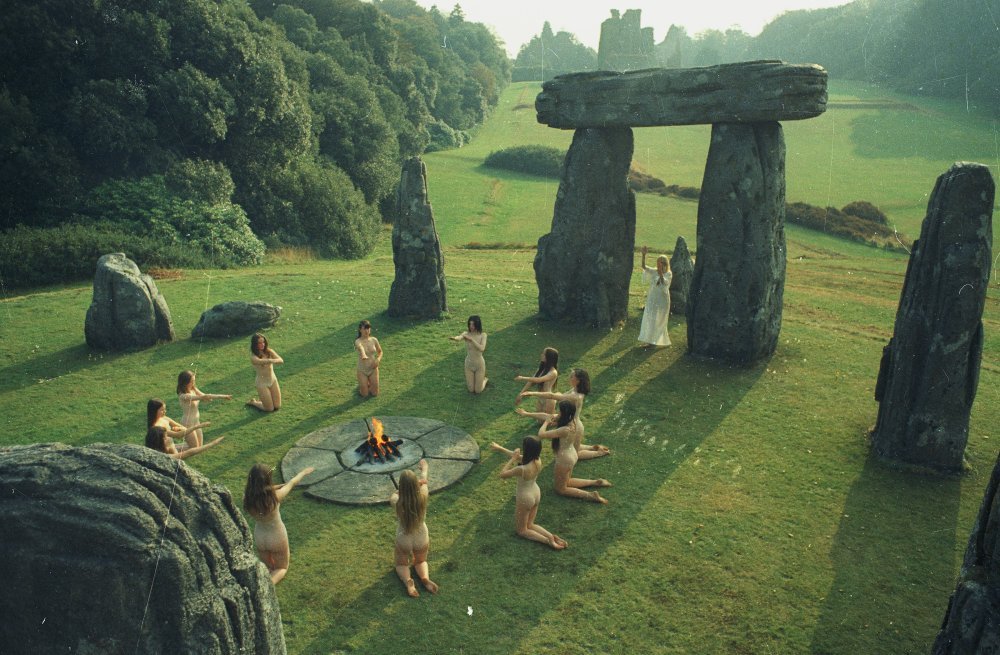
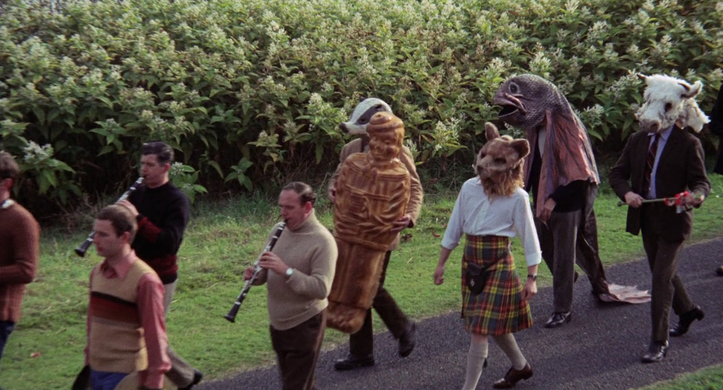
I hear (with a shudder of horror) that an American remake of this classic British Hammer Studios film is in production. Yet another insult to a fine film that underwent more than its share of insults. The original was idiotically marketed as a shock-horror picture, ensuring that the people who would have appreciated it never saw it and the people who saw it hated it. Then it was brutally re-cut in such a way as to make the film incomprehensible. That hatchet-job of a print circulated for years, an embarrassment to the director and the stars who performed brilliantly in it. The director eventually re-acquired the rights to it, and did his best to restore the original cut. I was present when the restored version was premiered in San Francisco, with the director in attendance. There have been two documentaries made about this sad chain of events, neither of which I’ve seen. If you rent the film, or see it on television, beware of the butchered print, which still circulates.
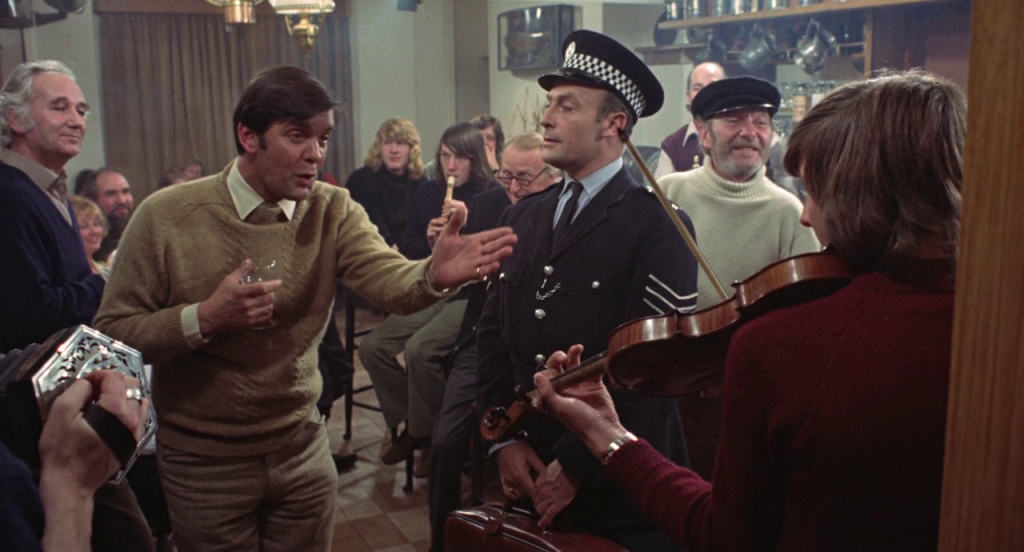 The plot of The Wicker Man is unique. A policeman (Edward Woodward) in the Scottish West Highlands gets a letter from a small island in the Hebrides. The island, under the influence of a warm current, is famous for exporting apples. The letter asserts that an island girl has gone missing. When the policeman arrives on the island to investigate, he discovers two peculiar things: 1) everyone on the island is trying to
 hide something from him, and 2) the islanders have abandoned Christianity for a revived form of ancient paganism. We are given, from the beginning, a clear picture of the policeman’s character. He is priggish, piously religious, and a virgin. He is utterly shocked by the happy-go-lucky lifestyle of the neo-pagan islanders, with their joyful sexuality, bawdy pub songs, and children dancing naked. Much of the background is explained in his interchanges with the island’s Laird, brilliantly played by Christopher Lee, and with the island schoolteacher (Diane Cilento). The policeman suffers the ultimate temptation to his piety (and virginity) in the form of the ravishingly beautiful tavern-keeper’s daughter (Britt Ekland), and is eventually drawn, step-by-step, into a trap that puts him into the Wicker Man. The trick of the
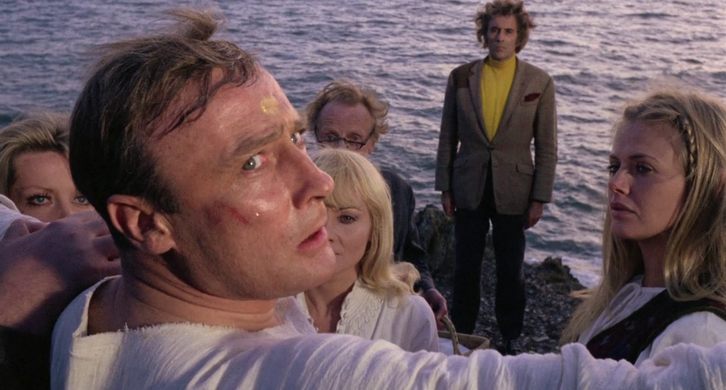 film is to take a person that one instantly feels contempt for, and put him into a situation where, eventually, you come to respect his view. I will not spoil the story for those who haven’t seen it. Suffice it to say that the tale recapitulates what must have happened a thousand times in a thousand villages of ancient Europe, as Christianity moved into and displaced pagan communities. The pagan lore presented in the film is reasonably authentic, given the explanation that it is presented as an artificial revival. The celtic music played in the film is wonderful.
Wednesday, May 17, 2006 — I Tremble For My Country
Posted by Phil Paine
on May 17, 2006
No comments
I tremble for my country whenever I see the bland, pasty face of our new Prime Minister, Stephen Harper, on television. It’s not that Harper is dumb. He is actually quite clever, and stands out dramatically in a party that is notoriously filled with ignoramuses and barely literate yahoos. It’s not that Harper is incompetent. He has shown remarkable political acumen, and he ran his election campaign brilliantly. It’s not that he is dishonest, or corrupt. I’ve seen no evidence of either. The problem is not that he is “socially conservative” or promoting a religious agenda. He shows no evidence of being any more socially conservative in his personal views than the average Canadian. Besides, there is not much market for the social conservative agenda in Canada, where people remain, on the whole, individualistic and fond of personal liberty. Canadians find religious zealotry distasteful. Read more »
(Coolidge 1985) Real Genius
Posted by Phil Paine
on May 16, 2006
No comments
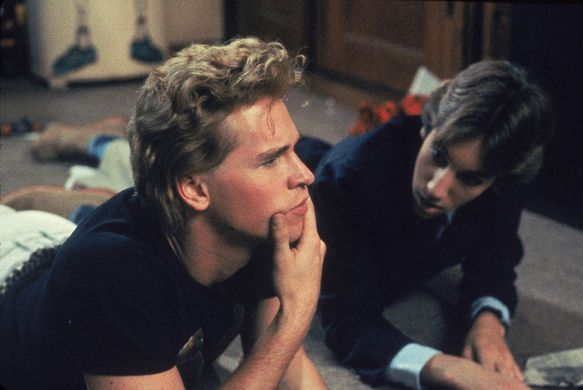 I’m fond of this goofy 1980s comedy about two whiz-kids who are scammed into working on a military laser project by a megalomaniac scientist. William Atherton played his patented “asshole” villain. Val Kilmer, who played the extroverted student, went on to a high-profile film career. Gabriel Jarret, who played the introvert, did not (it was perhaps an omen that his name was misspelled in the credits). His role was written with a degree of psychological realism, despite the absurd comedy plot. For once, the love interest isn’t a bombshell babe who is “plain” because she wears glasses and ties her hair back, then suddenly whips them off and unties her hair in the final scene. Instead, she is represented as extremely geeky. Boy geek falls for girl geek in a relatively credible way. For that alone, the film deserves some kind of award.
Monday, May 15, 2006 — French Canadian Swearing
Posted by Phil Paine
on May 15, 2006
No comments
The Catholic Church in Quebec has surprised everyone with a peculiar publicity campaign. They have purchased space on billboards, bus-stops, and other advertising places, in order to display swear-words. This requires some explanation. French Canadian swearing is the lamest on Earth. Don’t expect anything like the baroque splendour of Mexican swearing, or the earthy imagery in Russian curses, or even the repetitive sexual obsessions we are familiar with in English. The basic French Canadian swear words are distorted forms of the words for the articles used in a mass: “tabernacle”, “chalice”, “host”, “sacristy”.
However, this cannot be explained by any religious sensitivity. French Canada, especially in Quebec, is one of the most secular societies on the planet. Church attendance is very low in Canada, but by far the lowest in Quebec. The overwhelming majority of French Canadians have little or no interest in organized religion, though many will say they have some private, personal faith, uninfluenced by any church. Most people have no idea whatsoever what any of these “swear words” mean. If you catch your finger in car door, you say “tabernac’ ”, or “tabernache”. It doesn’t call up any image. It’s just a meaningless word. The average person, if asked to explain its origin, probably wouldn’t be able to tell you. By contrast, nobody who swears in English is unaware of the meanings of the swear words. Read more »