
First-time listening for February, 2006
Posted by Phil Paine
on February 28, 2006
No comments
15263. (Sergei Rachmaninov) Symphony #3 in A Minor, Op.44
15264. (Constantines) Shine a Light
15265. (Ani DiFRanco) Not A Pretty Girl
15266. (Friedrich von Flotow) Martha, or The Fair Maid At Richmond [opera highlights;
. . . . . d. Klobucar; w. Durham, Rotheberger, Plumacher, Volker, Wunderlich]
15267. (Northern Pikes) The Northern Pikes
15268. (Aaron Copland) Scherzo Humoristique: The Cat and the Mouse for Piano Solo
15269. (Aaron Copland) Piano Variations, 1930
Read more »
READING FEBRUARY 2006
Posted by Phil Paine
on February 28, 2006
No comments
14594. (Gavin Menzies) 1421, the Year China Discovered the World
14595. (Louise Levathes) When China Ruled the Seas
14596. (Birgit & Peter Sawyer) Medieval Scandinavia From Converson to Reformation,
. . . . . circa 800‑1500
14597. (Ellis Peters) The Summer of the Danes Read more »
Wednesday, February 22, 2006 — Finding Good Food
Posted by Phil Paine
on February 22, 2006
No comments
 Quite busy, lately. Working on the set of cable television show, and also doing some donkey work for a foreign trade mission. The rent will be late, but it will be paid.
 One reflection on life in Toronto: No matter how poor you are, there’s no problem getting really good food. I may have trouble making the rent, but I eat like an emperor. Eating well is, as far as I can see, cheaper than eating badly. I can make a supper of curried channa, steamed callaloo, and chicken, brazed in yogurt and spiced with cumin, sumac and blazing mitmita, served on a filling Ethiopian njeera, for a total cost of $3.50. I can wash it down with thick, top quality guava juice for three dollars a litre. I can lunch on bagels and fresh salmon & dill cream cheese for less than what it costs in a supermarket, or find an aged herb gouda at one third the supermarket price, if I keep my eyes open in Kensington Market.
 The trick is to keep a good shelf of spices. I buy them fresh, by weight, at House of Spice, a store that is more entertaining to walk into than any amusement park. By keeping the pantry stocked with staples (rice, pasta, potatoes, frozen peas and corn, wakame, njeera, crushed tomatoes), one can come across a cut of meat on sale and transform it into something special. Soups are my personal specialty. A hardy borsht with sour cream, a spicy shrimp and lemon grass in coconut or tamarind broth, a sturdy black bean and potato, a refreshing cold gazpacho. Anyone can make these in minutes. The skills involved are trivial.
 I mostly shop in free market stores, not corporate ones, which in this neighbourhood means mostly Tamil, Pilipino, Somali, Ethiopian, Korean and Jamaican food shops. All of them are geared to feeding big families on small budgets. Between them, I have a huge variety within a five minute walk. But within a twenty minute walk, I can get to anything conceivable, in Kensington Market (chaos and mysteries and bargains), or in St. Lawrence Market (highest quality, rarest items, such as muskox steak and arctic char flown in from Nunavut, an entire store devoted to caviar, and another that sells only hot sauces and mustards). Chinatown, Little India, and Greektown, all within walking distance, each provide their particular delights. I probably spend far less on food than the average person, but nobody could call me deprived.
 City life, with all its noise, rush hour chaos and carbon monoxide, does have some recompenses. Henry David Thoreau may have read the Mahabharataat Walden Pond, to fill his spiritual needs. But I find that a really good chicken tikka fills mine. I wonder, could I have lured Henry away from the pond with a really delicious kylbasa?
The Marriage of Heaven and Hell
Posted by Phil Paine
on February 20, 2006
No comments
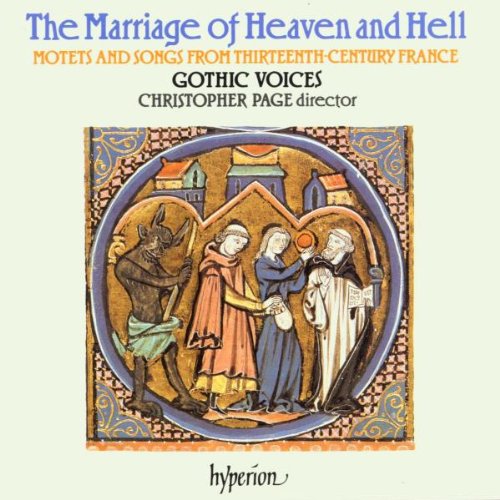 You could not find a better collection of early French motets than this one: “The Marriage of Heaven and Hell: Motets and Songs from Thirteenth Century France” [Hyperion CDA66423], performed by the Gothic Voices, under the direction of Christopher Page, who is also the harpist. Most of these motets are anonymous, but a few are credited to trouvères: Blondel de Nesle, Colin Muset, Gautier de Dargies, and the best known, Bernart de Ventadorn. However, the motet form transforms the feeling of the trouvère songs. They lose their intimate quality, and the poetry of the lyrics is submerged. It’s not really possible to follow lyrics in a motet, even if you know the language well. The best you can do is catch a word here and there. People didn’t listen to motets for the same reason they listened to love ballads and heroic lais. The motet was a game. It took familiar songs and played with them, twisting them out of recognition. In much the same way, 1950’s “cool” jazz took show tunes and love songs and manipulated them in fashions completely at odds with their original intent.
Friday, February 18, 2006 — A New International Body
Posted by Phil Paine
on February 18, 2006
No comments
I propose that Canada initiate the formation of a new international body. Membership would be defined by the following factors: 1) a population of less than thirty-five million, 2) a per capita GNI (Gross National Income) over US$20,000, and 3) a record of fully functioning democracy for a minimum of fifty years. Switzerland, which qualifies, would be omitted by dint of its special neutrality and banking interests. The following countries would be invited: Austria, Australia, Belgium, Denmark, Finland, Iceland, Ireland, Luxembourg, the Netherlands, New Zealand, Norway, and Sweden. In addition, I would suggest that Greenland and the Faroe Islands, both entities semi-autonomous from Denmark, be invited to participate as full members. Canada has a special interest in close co-operation with Greenland. Read more »
Heaven 17
Posted by Phil Paine
on February 9, 2006
No comments
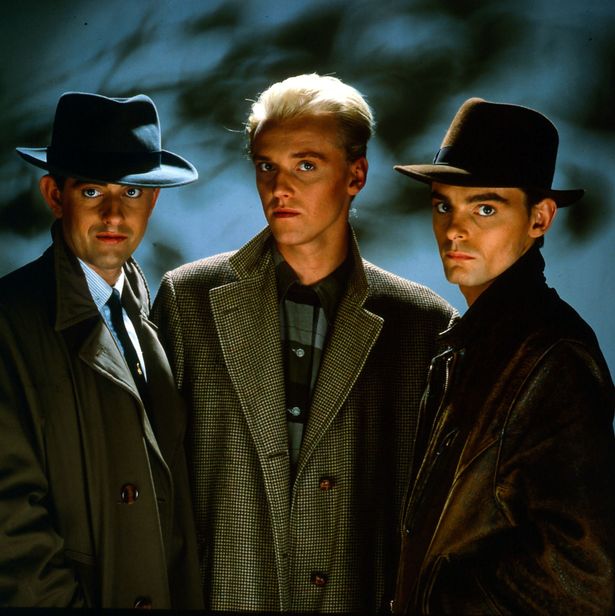 This is a British synthpop band originating in Sheffield, England in the early 1980s, partly from former members of the Human League. I have their first two (and most successful) albums, Penthouse and Pavement(1981) and The Luxury Gap(1983). From the first album, the single “We Don’t Need This Fascist Groove Thang” gained some notoriety when the BBCbanned it from play for political reasons. However, “Geisha Boys and Temple Girls” and “We’re Going to Live For a Very Long Time“ appealed to me more. They achieved greater success with the second album, from which “Temptation” and “Let Me Go” were the band’s biggest UKand UShits respectively. A current listener will be most taken by the primitive “proto-techno” elements: cheesy synthesizers and drum machines. Unlike most of the synthpop bands of the time, they had catchy melodies, and used the crude electronic tools to good effect.
14594. (Gavin Menzies) 1421, the Year China Discovered the World
Posted by Phil Paine
on February 7, 2006
No comments
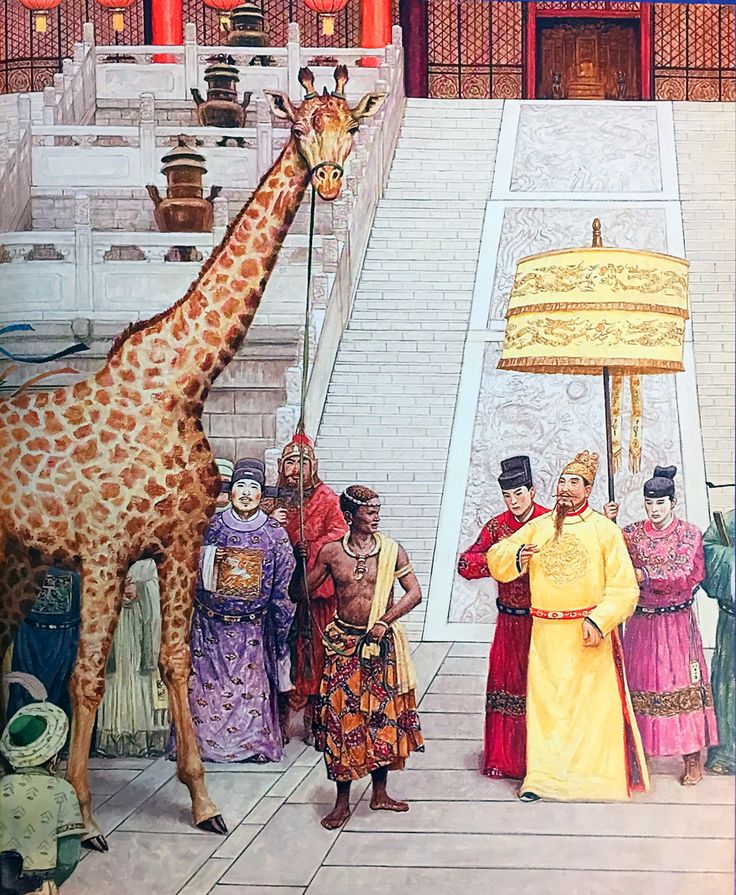 Farley Mowat engaged in some unrestrained speculation with his “Alban” prehistoric explorers. Now, Gavin Menzies goes absolutely wild with speculation in his “reconstruction” of a gigantic global exploration by the Chinese admiral Zheng He in the year 1421.
It is well known that a large Chinese Imperial fleet, under the direction of Zheng He (or Heng Ho), the eunuch aide-de-camp of the early Ming emperor Zhu Di, undertook seven long voyages that combined trade, diplomatic and exploratory motives. Chinese trade and exploration of the East African coast is well accepted by historians. Zheng He’s voyages are well documented by his secretary, Ma Huan, whose chronicling of some of the voyages was widely printed and distributed, and there are collateral accounts by Fei Xin and Gong Zhen, both officers on some of the voyages. There is also plenty of corroboration in Ming dynasty public records. Zheng He’s celebrity was such that plays were being performed about him while the voyages were still going, and a century and a half later, an immensely popular historical novel, Journey of the Three-Jeweled Eunuch to the Western Oceans by Luo Maodeng, retold the story with embellishments. Read more »
House, M. D. [television series]
Posted by Phil Paine
on February 5, 2006
No comments
 None of the big medical shows on television has succeeded in gaining my serious interest ― until now. I love this show. And what is most astonishing about it is that the grubby, surly, sarcastic, and extremely American main character is played by Hugh Laurie, who played Bertie Wooster in the Jeeves and Wooster, and many hilarious characters in the Blackadder series. Laurie’s American voice and manner are completely convincing. The series assumes the audience has a reasonable knowledge of medicine and physiology, and tackles hard issues without slipping into the tiresome evasiveness that American TV shows usually get into when faced with real problems. In this show, people decide things. Many thanks to Isaac White for bringing over four episodes of this show.
