15000. (Crowded House) Alone Together
15001. (Neil Finn) Try Whistling This
15002. (Split Enz) The Living Enz
15003. (Tim Finn) Before & After
15004. (Crowded House) Recurring Dream: The Very Best of Crowded House
15005. (Crowded House) Recurring Dream Bonus Live Album
15006. (Crowded House) Phil’s Crowded House Miscellany
15007. (Dmitri Shostakovich) String Quartet #1 in C, Op.49
15008. (Dmitri Shostakovich) String Quartet #2 in A, Op.68
Read more »
First-time listening for January, 2006
Posted by Phil Paine
on January 31, 2006
No comments
READING JANUARY 2006
Posted by Phil Paine
on January 31, 2006
No comments
(Stephen Leacock) Behind the Beyond
. . . . 14545. (Donald Cameron) Introduction [preface]
. . . . 14546. (Stephen Leacock) Behind the Beyond, A Modern Problem Play [article]
. . . . 14547. (Stephen Leacock) With the Photographer [article]
. . . . 14548. (Stephen Leacock) The Dentist and the Gas [article]
. . . . 14549. (Stephen Leacock) My Lost Opportunities [article] Read more »
14591. (Farley Mowat) The Farfarers
Posted by Phil Paine
on January 29, 2006
No comments
This is Farley Mowat’s odd book about a possible pre-viking European presence in the Canadian Arctic.
Mowat is very careful to warn the reader that he is engaging in a kind of speculative archaeology. He even intersperses the text with little passages of adventure fiction. But it is also clear that he has convinced himself pretty thoroughly that his speculations correspond to what actually happened. And the result is, of course, one of those books where a chapter begins with the assertion that something might have happened , which by the end of the chapter has been gradually transformed into what certainly did happen , and then becomes the premise for the next chapter, which begins with if that happened, then this might have happened , and so on. Gradually, a huge sequence of suppositions begins to have the appearance of a framework of solid evidence, when it is most clearly not.
What he begins with is something which is verifiably true. The eastern Arctic of Canada is littered with odd ruins and megalithic structures that can not be easily attributed to the Inuit, or to the earlier Dorset or Thule cultures. Nor do they appear to be built by the Norse. They are definitely very old. The most interesting concentrations are on the western shore of Ungava bay, and in a bay immediately south of the spectacular Torngat range, in Labrador. Read more »
14588. (Harry Mulisch) The Discovery of Heaven [= De ontdekking van de Hemel, tr. from Dutch by Paul Vincent]
Posted by Phil Paine
on January 28, 2006
No comments
This is a reasonably interesting novel, though not economically written. It’s a sprawling omnibus of digressions, combining fantasy, mysticism, politics and a kind of Jules et Jim triangle romance. Mulisch is intelligent, learned, and absolutely saturated with conventional systems and intellectual orthodoxy. There is a lot of thought in this book, but not a particle of original thought. This is, unfortunately, supposed to be the great masterpiece of modern Dutch literature. Well, the Dutch have blessed the world with wonderful painting and architecture, and their trance djs are superb, but literature just doesn’t seem to be their strong point. Nevertheless, I might recommend it for a lazy afternoon’s reading. The interaction of the characters is sometimes interesting.
14587. (S. Craig Watkins) Hip Hop Matters ― Politics, Pop Culture, and the Struggle for the Soul of a Movement
Posted by Phil Paine
on January 27, 2006
No comments
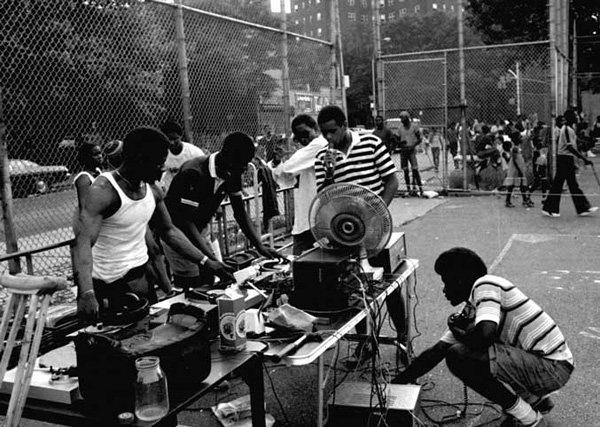 A straightforward history of the early days of Hip Hop, focusing more on the producers, record labels and people who ran the business end than on the performers. Hip Hop seems to have coalesced into existence simultaneously in several U.S. cities in the early seventies, but a conventional “birthday” is the August 11, 1973 party in a basement apartment in the Bronx. Soon, people DJs like Afrika Bambaataa and Kool Herc were throwing block parties featuring breakbeats and scratching. Emcees, began spontaneously rapping to the beats.Through the seventies, it was a spontaneous, informal and barely noticed seen…it was six years before the first Hip Hop album was recorded and released. As the musical fashion saturated the world, money started piling up, and the inevitable struggle between art, social conscience, and business interests. This is the part that interests the author. His analysis is common sense: money soon overwhelms art and social causes.
An interesting quotation: “Who would pay money for something they can hear for free at parties? Let’s keep it underground. Nobody outside of the Bronx would like this stuff anyway.” —- Joseph Saddler, aka Grandmaster Flash, 1979, when approached with the idea of putting rap music on records.
14586. (Valerio Massimo Manfredi) The Last Legion
Posted by Phil Paine
on January 26, 2006
No comments
An interesting historical novel set in the period of Romulus Augustus, the last Roman Emperor in the Western Empire. The book is translated from Italian. It is fast-paced adventure fiction, written in the spirit of Alexandre Dumas. There is a “surprise” ending, which the reader will probably see coming fairly early in the game. Though most of the action takes place in Italy, it is suffused with the “Matter of Britain”. Doesn’t anyone ever write about late Roman Spain, or Norica, or Africa?
14577. (John Donne) The Selected Poetry of Donne [ed. Marius Bewley]
Posted by Phil Paine
on January 25, 2006
No comments
Donne is best when he writes of love or death, dullest when building “metaphysical” structures or playing games with theology.
Where, like a pillow on a bed,
A pregnant bank swell’d up, to rest
The violet’s reclining head,
Sat we two, one another’s best.
Our hands were firmly cemented
With a fast balm, which thence did spring,
Our eye-beams twisted, and did thread
Our eyes, upon one double-string;
So to intergraft our hands, as yet
Was all the means to make us one,
And pictures in our eyes to get
Was all our propagation.
14576. (Kurt W. Treptow) Vlad III Dracula ― The Life and Times of the Historical Dracula
Posted by Phil Paine
on January 24, 2006
No comments
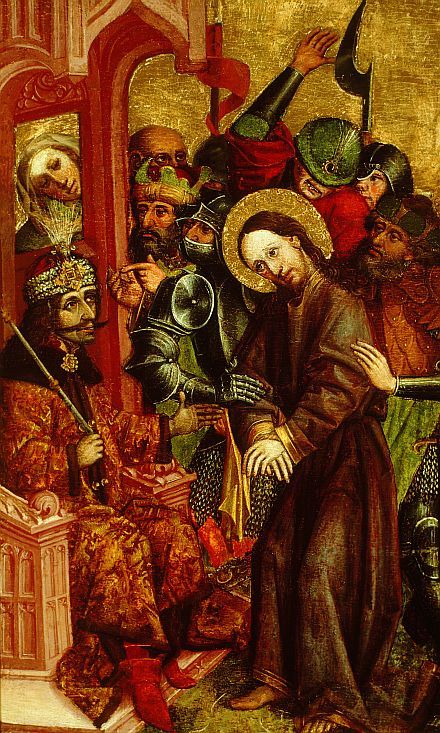
Vlad the Impaler represented as Pontius Pilate judging Jesus Christ, 1463 (artist unknown)
This seems to be the best book on Vlad III of Wallachia, the historical “Dracula”. It at least explodes the silliest interpretations, put forward by Marxists under the Ceaucescu regime, that seem to have found their way into many secondary sources. Vlad seems to have been a perfectly ordinary little gangster, committing plenty of atrocities, but not much different in style and motivation from those of other thugs ruling principalities. Compared to the colossal outrages of the religious wars that tore Germany apart, soon after, it was all small potatoes.
While Vlad enjoyed torturing people and impaling them, he was no more vicious than, say, the Reformation theologian John Calvin, who enjoyed torturing people by slowly roasting them on a spit while their heads were soaked with cold water to prolong the agony .… a torture that he once condemned two children to. And he isn’t any more of a monster than Guatamala’s dictator José Ríos Montt, whom Ronald Reagan admired and called “a man of great personal integrity and commitment.”
14573. (René Descartes) Les Méditations Metaphysiques
Posted by Phil Paine
on January 22, 2006
No comments
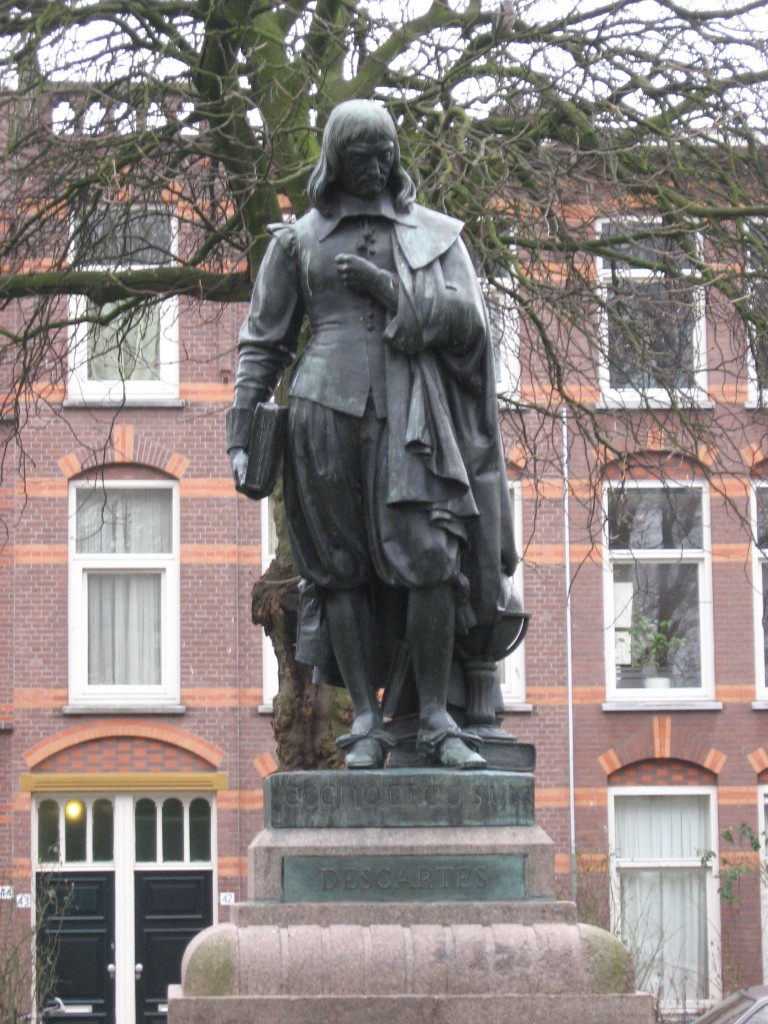
A statue of René Descartes in Den Haag, Netherlands. I once sat below it, eating a lunch of Patatje Joppie (fries with Joppiesaus) and pickled herring.
Descarte’s chief importance to us now lies in his mental attitude, and his approach to solving problems. He did not always come to conclusions that I can accept, and sometimes did not live up to his own methods, but the significant thing is that he tried to look at the world in a way that would be familiar to a scientist in our time, or to any scholar, lawyer, doctor, or technician trying to maintain an objective, rational discipline.
Formally, the Meditations are written in the “dialectic” style that was the heritage of medieval and renaissance philosophy. But Descartes was not interested in the medieval technique of comparing authorities and making an “argument”. He was more interested in the questions: “What can I claim to know?” “How shall I distinguish between what I believe, and what I can claim as proven?”
Every scientist and lawyer is now familiar with the importance of these questions. I can step outside and see a man robbing another man at gunpoint. After the event, I can give testimony to this, but other people need not believe me if I cannot corroborate it. I myself might not be certain, for instance, that it was not a vivid dream, which I mistook for experience. A chemist might see a significant reaction in a test-tube. Yet, he expects other scientists to suspend judgment on his report until it can be duplicated. The phrasing of his report will be carefully thought out to reflect the epistemological and judicial considerations that science depends on. There are hints and premonitions of this attitude in earlier thinkers, like Aristotle, Euclid, Ibn Sinna, and Aquinas, but it is Descartes who brings them to the forefront, and concentrates on them. Read more »
14572. (D. M. LeBourdais) Canada’s Century
Posted by Phil Paine
on January 20, 2006
No comments
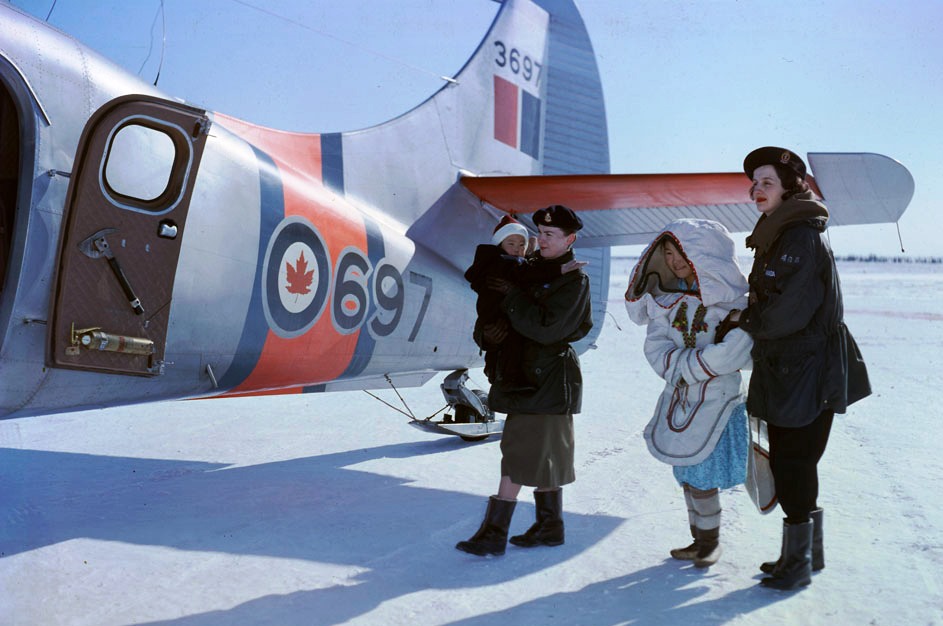
Nursing Sister at Fort Churchill, Manitoba, preparing to board an RCAF De Havilland Otter. Canadian-made bush planes such as the Otter and Beaver were the “covered wagons” of the Canadian North (Library and Archives Canada Photo, MIKAN No. 4234435)
This book was published in 1956, and it reflects a time when Canadians had very different things to think about. This was the period when a number of people became inspired by visions of the Northern Frontier. French-speaking Canadians seem to have been more caught up in it than English-speaking Canadians, who seem to have been more attracted to the magic of the blooming suburbs, but there were books like this published in both languages. The North was bristling with potential mineral wealth. The 1940s had already seen a Pioneer Movement, which was especially encouraged by influential people in Quebec, who wanted to divert the leakage of French Canadians migrating to New England (where they would certainly lose their language) into the Northern and Western Canada, where they would be able to keep it. This meant moving into the last remaining untouched patches of possible agricultural land in North America, and homesteading under the most extreme conditions. Some settlements failed, sometimes homesteads would be abandoned in moment of despair, the coffee pot left boiling on the stove. (It’s ironic that my mother, from an ancient Quebec family along the St. Lawrence, experienced both. Her family moved to Massachusetts to get work in the mills, but when she finished school, she returned to Canada and wound up in a subarctic Ontario mining town.)