(Hunt 1982) The Mysterious Stranger
(Honda 1957) The Mysterians [地球防衛軍; Chikyû Bôeigun]
(Trelfer 2014) Dark Corners Review: (175) The Mysterians
(Wright 2010) Murdoch Mysteries: Ep.39 ― The Tesla Effect
(Breakston & Crane 1959) The Manster [双頭の殺人鬼]
(Trelfer 2018) Dark Corners Review: (322) The Manster
(De Felitta 1981) Dark Night of the Scarecrow
(Morgan 1987) Doctor Who: Ep.654 ― Time and the Rani, Part 1
(Morgan 1987) Doctor Who: Ep.655 ― Time and the Rani, Part 2
(May 1940) The Invisible Man Returns
(Morgan 1987) Doctor Who: Ep.656 ― Time and the Rani, Part 3
(Morgan 1987) Doctor Who: Ep.657 ― Time and the Rani, Part 4
(González 1965) The Fool Killer Read more »
FILMS – NOVEMBER 2018
Posted by Phil Paine
on November 30, 2018
No comments
First-time listening for November 2018
Posted by Phil Paine
on November 30, 2018
No comments
25328. (Richard Strauss) Macbeth, Tone Poem after Shakespeare for Orchestra
25329. (Seun Kuti & Egypt 80) Many Things
25330. (Infected Mushroom) Converting Vegetarians
25331. (Hildegard of Bingen) O vis aeternitatis
25332. (Hildegard of Bingen) Nuch aperuit nobis
Read more »
READING – NOVEMBER 2018
Posted by Phil Paine
on November 30, 2018
No comments
24016. (Philip José Farmer) Sail On! Sail On! [story]
24017. (Joan Collins) The Snow Queen [ill. Kathie Layfield]
24018. (Clive Gamble) Archaeology: The Basics
The Magazine of Fantasy [& Science Fiction], Vol.1, #1, Fall 1949:
Read more »
Seventh Meditation on Democracy [written October 1, 2008] REPUBLISHED
Posted by Phil Paine
on November 10, 2018
No comments
 In the beginning years of this blog, I published a series of articles called “Meditations on Democracy and Dictatorship” which are still regularly read today, and have had some influence. They still elicit inquiries from remote corners of the globe. They are now buried in the back pages of the blog, so I’m moving them up the chronological counter so they can have another round of visibility, especially (I hope) with younger readers. I am re-posting them in their original sequence over part of 2018. Some references in these “meditations” will date them to 2007–2008, when they were written. But I will leave them un-retouched, though I may occasionally append some retrospective notes. Mostly, they deal with abstract issues that do not need updating.
 A few days ago, I was in the subway, and I overheard a conversation about our current national election. Two boys who, from their appearance, could have been no further along in school than grade nine or ten, were discussing the televised debates between the leaders of the five major political parties. What struck me, as I listened in, was that the discussion was cogent and intelligent. One of the boys, who seemed the youngest, was particularly articulate, and his opinions were not the simple parroting of some adult he had heard, or the pursuit of a party line. In fact, his analysis of the debate showed keener observation and judgment than that of the professional commentators who dissected the debate after the broadcast. Read more »
Image of the month: Kel Tagelmust
Posted by Phil Paine
on November 1, 2018
No comments
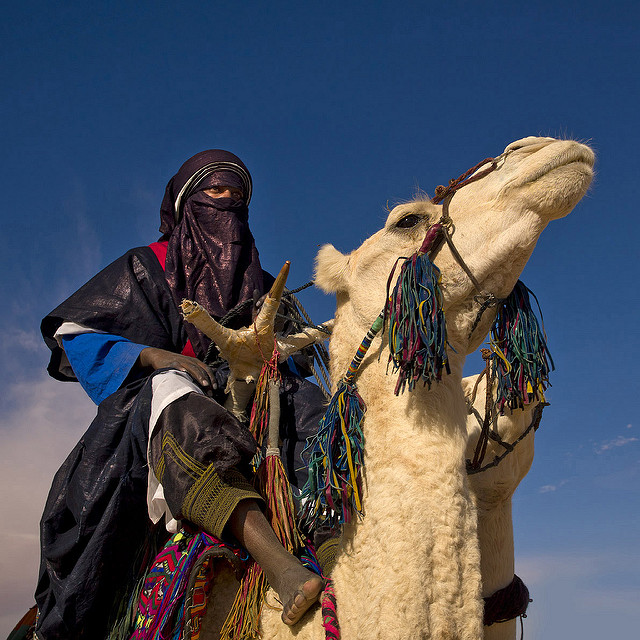 A Tuareg noble of the Sahara, exactly as I remember such men. They are occasionally referred to as kel tagelmust (veiled people) because of the headgear and robe dyed with shimmering indigo. This garment is fine-tuned for the Sahara’s violent sandstorms, blistering sun, wild swings in temperature, and is designed to conserve precious body moisture. Perhaps it’s the inspiration for the “stillsuit” in Frank Herbert’s Dune. The seven tribal confederations of the Tuareg always seemed to me a much more plausible model for Herbert’s science fiction classic than the Badawi of Arabia, and the history of the Sahara and Maghrib have episodes that parallel the story of Dune.
FILMS – OCTOBER 2018
Posted by Phil Paine
on October 31, 2018
No comments
(Young 1962) Dr. No
(Sheldon 1981) Lovely But Deadly
(Trelfer 2018) Dark Corners Review: (321) Lovely But Deadly
(Schaffner 1965) The War Lord
(Raymond 1931) The Speckled Band
(Wright 2010) Murdoch Mysteries: Ep.38 ― In the Altogether
(Mann 2008) Les enquêtes de Murdoch: Ep.1 ― D’un courant à l’autre
(Elvebakk 2014) Ballet Boys
(Seiler 1939) Dust Be My Destiny
(Waters 1994) Serial Mom
(Pavlou 1986) Rawhead Rex
(Tenold 2018) Brandon’s Cult Movie Reviews: Rawhead Rex
(Sachs 2016) Little Men
Read more »
First-time listening for October 2018
Posted by Phil Paine
on October 31, 2018
No comments
25296. (Inerane) Music from Agadez
25297. (Silvius Leopold Weiss) Suite #1 in F for Lute
25298. (Silvius Leopold Weiss) Suite #2 in D for Lute
25299. (Silvius Leopold Weiss) Suite #3 in G Minor for Lute
25300. (Dayglo Abortions) Out of the Womb
Read more »
READING – OCTOBER 2018
Posted by Phil Paine
on October 31, 2018
No comments
24008. [2] (Ray Bradbury) Dandelion Wine
24009. (Ian Tattersall) The Acquisition of Human Uniqueness [article]
24010. (T. S. Vasulu) Genetic Structure of a Tribal Population: Breeding Isolation among the
. . . . . Yanadis [article]
24011. (Vera Southgate) The Princess and the Frog [ill. Martin Aitchison]
24012. (Alissa Mittnik et al) The Genetic Prehistory of the Baltic Sea Region [article]
Read more »
Second Meditation on Dictatorship [written March 1, 2008] REPUBLISHED
Posted by Phil Paine
on October 10, 2018
No comments
In the beginning years of this blog, I published a series of articles called “Meditations on Democracy and Dictatorship” which are still regularly read today, and have had some influence. They still elicit inquiries from remote corners of the globe. They are now buried in the back pages of the blog, so I’m moving them up the chronological counter so they can have another round of visibility, especially (I hope) with younger readers. I am re-posting them in their original sequence over part of 2018. Some references in these “meditations” will date them to 2007–2008, when they were written. But I will leave them un-retouched, though I may occasionally append some retrospective notes. Mostly, they deal with abstract issues that do not need updating.

The argument behind this series of meditations is that aristocratic elites, whether they are dressed up in military uniforms, business suits, or the regalia of royalty, are identical in purpose and function. Differences between them are trivial and cosmetic, not structural. The term “dictatorship” applies equally to all places where an unelected gang of hoodlums rules over people and territory, whatever their supposed ideology or whatever style they chose to prance around in. I further contend that they are neither morally legitimate, nor “government” in the sense that democratically elected administrations are. Dictators are merely criminals, no different from the criminals that rob convenience stores or attack women in darkened car parks. The only difference is the amount of money they steal and the number of people they murder or maim.
Next, I have argued that rule by aristocracies is a constant danger to human society in any time and any place, independent of a society’s level of wealth, or available technology. I argue that there are no necessary or predestined “stages” in the organization of human society. Morally good and beneficial democratic social arrangements can be made at any time and in any place, by any group of people, large or small. Language, ethnicity, location, and degree of wealth are not structurally relevant to democratic practice, and democratic practice does not originate with, or “belong to” any particular cultural group. Similarly, dictatorship can occur in any human group. Immoral, diseased societies can be made at any time, in any place, by any group of people, large or small. Both possibilities always co-exist.
Image of the month: a fine bridge
Posted by Phil Paine
on October 1, 2018
No comments
 The Burlington Canal Vertical Lift Bridge, in Burlington, Ontario — built in 1962. I wish I could credit the photographer, who has given it a special mood and magic.