(Konchalovskiy 1997) The Odyssey
(McNaughton 1972) Monty Python’s Flying Circus: Ep.34 ― The Cycling Tour
(Cimber 1984) Yellow Hair and the Fortress of Gold
(Trelfer 2018) Dark Corners Review: (313) Yellow Hair and the Fortress of Gold
(Bridge 2017) How the Universe Works: Ep.42 ― Strangest Alien Worlds
(Betuel 1985) My Science Project
(Williamson 2018) How the Universe Works: Ep.43 ― Are Black Holes Real?
(Greene 1959) The Cosmic Man
Read more »
FILMS – SEPTEMBER 2018
Posted by Phil Paine
on September 30, 2018
No comments
First-time listening for September 2018
Posted by Phil Paine
on September 30, 2018
No comments
25254. (Danger [Franck Rivoire] ) 太鼓 [Taiko]
25255. (Paul Oakenfold) Essential Mix: Live in China
25256. (Kanye West & Kid Cudi) Kids See Ghosts
25257. (Girolamo Frescobaldi) Ricercar #9 con quattro soggetti for Harpsichord
Read more »
READING – SEPTEMBER 2018
Posted by Phil Paine
on September 30, 2018
No comments
23981. (Barbara Newhall Follett) The House Without Windows and Eepersip’s Life There
23982. (John Ljungkvist & Per Frölund) Gamla Uppsala ― The Emergence of a Centre and a
. . . . . Magnate Complex [article]
23983. (John T. Koch) La fórmula epigrafica Tartesia a la luz de los descubriemientos de la
. . . . . necrópolis de Medellín [article]
23984. (E. Lynn & Chuck Morton) Ferrets
Read more »
27492. (Homer) The Odyssey [tr. Stephen Mitchell]
Posted by Phil Paine
on September 11, 2018
No comments
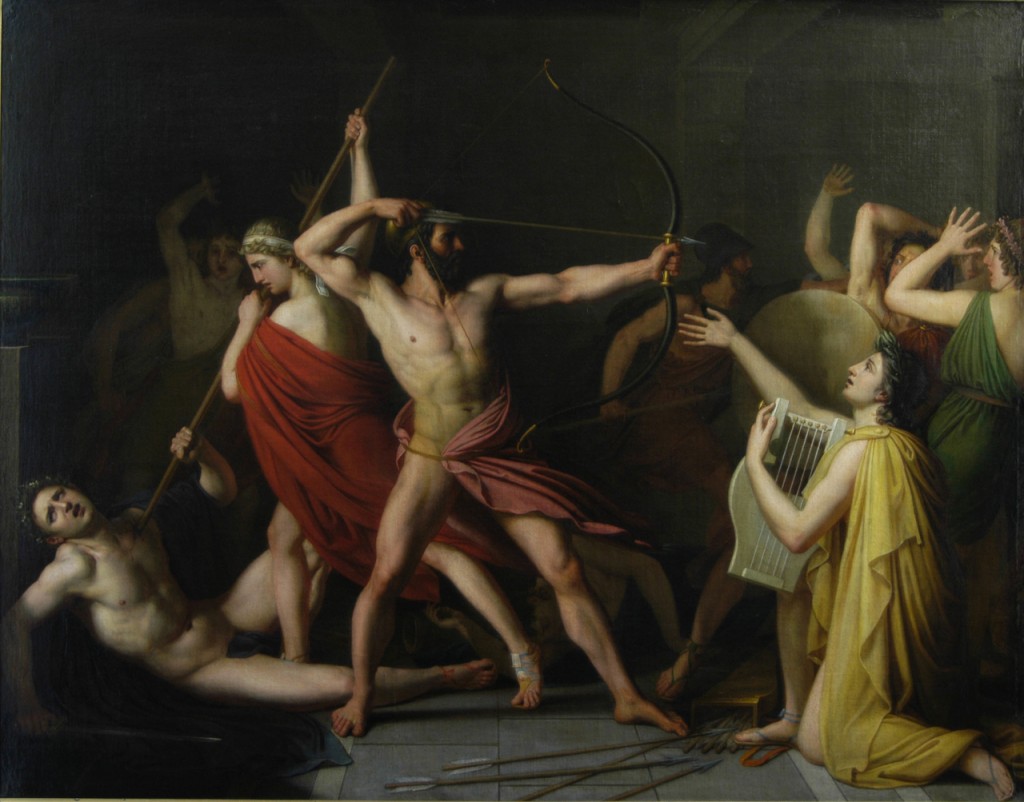
Ulysse et Télémaque massacrent les prétendants de Pénélope (1812) by Thomas Degeorge
Before the fatal attraction of Science Fiction, my early childhood reading was dominated by dinosaurs, jungles, volcanoes and tales of explorers and scientists. But there was also a niche set aside for ancient myth, particularly Greek myths. I read a crumbling old copy of Charles Kingsley’s The Heroes: Perseus, Jason, Theseus, and Jason in particular appealed to me, a taste firmly cemented by repeated viewings of Harry Harrihausen’s magical stop-motion effects in the film Jason and the Argonauts. I also possessed (I’m not sure how) a little blue book, something proferred as “educational” from a Canadian publisher, entitled Classical Mythology in Song and Story: Part Two, Epic Heroes. It was choc full of line drawings from some uncredited artist. These were reasonably good, and some were quite sexy. But most delightful of all, the two endpapers were maps, showing in a serpentine dotted line the journey — it actually said “wanderings” in the map ― of Odysseus. The land of the lotus-eaters was Tunisia. Scylla and Charibdis stood ferociously on either side of the straight separating Sicily from Calabria. No doubt this explains the preponderance of Italian immigrants to Canada from those two provinces. I can’t express how much maps meant to me at that age. Maps were my catnip. Put a map on the end-papers of anything, and I would read it.
The retellings of the myths in these two books were in old-fashioned styles, a mixture of late 19th century British and 1930’s Canadian prose. I rated the various heroes differently. Hercules, a mere muscleman with obviously limited intelligence, struck me as more of a “hero” for the bullies that waited to pounce on me on the way to school. The pompous characters of the Iliad did not impress me at all, and the Trojan War didn’t seem very interesting. For all that I liked Jason, he was too dependent on help from various gods, oracles, and crewmen. The Argonautica is a pretty good story, but Jason himself is basically just a generic teen adventure hero. It’s with the retelling of the Odyssey that the book hit gold. Odysseus was no pink-cheeked adolescent, certainly no wimp, and obviously had a brain… though not necessarily the best judgement. The adventures were not a mere parade of monsters. The Cyclops was not just a dangerous animal, but a particularly gruesome opponent that Odysseus could converse with and outwit. There were subtler perils, mostly variants of the femme fatale, and the temptations of drug-induced ecstasy and timelessness. Odysseus even goes to Hell ― the morbid cold and misty Hell of the Greeks, not the silly barbecued Christian Hell.
Eventually, I read the actual epic, first in the Richard Lattimore translation, then later in the Penguin Classics version translated by E. V. Rieu. But it wasn’t quite the same. As a teenager and an adult, reading could not have the same sense of spontaneous revelation that it had for a small child. The Odyssey ceased to be a “story” and became “literature,” consumed with the same pedantic industry that I read Chaucer, Hemingway or Tobias Smollett. That is to say, not without appreciation and pleasure, but not with the wide-eyed gusto of a small child unwrapping a Crispy Crunch bar.
Classics are seldom reread, even by omnivorous readers. Most of the bookish people I know have read an assortment of classics in their high school or college years, then filed them away in memory, feeling little urge to look at them again with the perspective of age. There are far too many newer things competing for attention. Gradually, such classics dim into vague impressions, static snapshots of particular scenes, or truncated plot summaries. Moby Dick the whale is God. Anna Karenina throws herself under a train. Gargantua wipes his ass with a duck.
But I’m a chronic rereader. Even some apparently simple books never seem to come out the same on successive readings. I’ve read Edgar Pangborn’s A Mirror For Observers eight times. I’m looking forward to the ninth. I would no more be finished with it than I would cease listening to “St. James Infirmary Blues” because I’ve already heard it. So I’ve just reread The Odyssey, after many years, this time in the 2013 translation by Stephen Mitchell, whose prodigious industry has already produced an Iliad, a Gilgamesh, and a Bhagavad Gita. Anyone taking on the task of translating an ancient work is faced with a basic choice at the very start: whether to use “elevated” language or “colloquial” language, or some compromise between the two. Mitchell chose the colloquial approach without compromise, noticeably more than either Lattimore or Rieu. I can understand this, because an “elevated” style does not come easily either to an English language reader or to an English language writer. In societies where caste and class are integral to every aspect of life the use of a special “high” language in poetry or prose comes naturally enough ― in some languages there is an entirely different system of grammar for aristocratic or poetic speech. But most English-speaking societies do not hold class and caste as sacred ideals, and in English such a linguistic distinction conveys only insincerity. As a trivial, but illustrative example, consider recordings of popular songs by opera stars. Operatic singers are taught a very specific formula of enunciation, based on the Italian values of vowels and consonants, designed to make opera lyrics clearer and show off the exacting vocal discipline of operatic singing. We are not expected to fall into a suspension of disbelief in which we are truly experiencing the powerhouse lungs of the diva as a frail consumptive waif committing suicide. Opera singers can’t abandon this discipline and enunciate like a Canadian accountant, a sheep rancher in the Australian outback, or a teenager in Van Nuys, California. So no matter how much verve or technical skill they put into a popular song, it is bound to give an impression of artificiality and false emotion. The popular singer’s enunciation matches that of colloquial language, and thus sounds more sincere. However, an Italian operatic aria does not sound the least bit insincere to an Italian. The same disciplined enunciation can be applied to an Italian folksong or pop song, and Pavarotti could switch from Verdi’s “De’ miei bollenti spiriti” to the folksy Neapolitan “Fenesta vascia” without batting an eye. The closest that one usually comes to seeing the use of the “elevated” language convention in English is in 1950’s historical movies set in ancient Rome, where the Senators all speak in British Shakespearian Stage accents, the centurions are Americans, and the slaves are Cockneys or come from Brooklyn. This is not a viable template for translating the Odyssey if one expects it to be read without laughing.
One thing I noticed this time around is that the Odyssey is nothing like a “folk epic”. I’ve read or heard quite a few examples of genuine folk epics, and this work doesn’t even remotely resemble them. It gives every indication of being the conscious product of a single author who conceived of it as a unified work, in short of being “literature”, even if it was composed and performed orally. That is not to say that it doesn’t contain folkloric elements. I think what Homer (or whomever) was doing was taking a body of existing folk song, itself based on an established mythology, and embedding it into a coherent narrative, which is in turn framed by an overarching meta-narrative. There is nothing impromptu about any of this construction. Everywhere in it one sees the fingerprints of a writer, someone carefully selecting elements, viewing them from multiple angles, calculating their timing and effect, and using them as instruments of emotional manipulation. The “hero” of the constructed work is not Odysseus, but young Telemachus, who occupies a large part of the total narrative, and whose transformation from ineffectual youth to effective adult is determined at first by the absence of his father, then by his uncovering indirect evidence of his father’s adventures from testimony, then finally by Odysseus’ returning and re-establishing his heritage. As a reflection of this process, Telemachus is guided by Athena in the form of the visitor Mentor. Odysseus’ fantastic adventures are embedded in this meta-frame in fragmentary form. Everywhere in the narrative it is the psychological, not the physical events that are emphasized. No matter how many monsters appear, most of the narrative is like a realistic novel:
While they were speaking Eurýnome and the nurse were making the bed by torchlight, spreading upon it soft sheets and blankets. And when they had finished their work, soft sheets and blankets. And when they had finished their work, Eurycléa went back to her room for the night, and Eurýnome, holding a torch, accompanies them to the bedroom and left them there. And in great joy the two of them lay at last in each other’s arms. Telemachus and the cowherd and swineherd stopped dancing, and told the women to stop as well and dismissed them, and then they went to sleep in the shadowy hall. When Penelope and Odysseus had taken their pleasure in the joys of love, they told each other their stories. She told him of everything she had endured in the palace with the despicable crowd of suitors encamped there, using her as an excuse to slaughter so many cattle and sheep and to drink so much of their wine. And Odysseus told her of his great exploits in war, the suffering he had inflicted and what he had suffered on his way home, and she listened to him, enchanted, and she did not close her eyes until he had finished.
There are as many female characters in the Odyssey as there are male, and the narrative either puts them in forefront, has them behaving proactively, or attempts to describe their points of view. It is Helen, not Menelaus, who tells Telemachus and the assembled banqueters the tale of Odysseus’ fighting at Troy. Folk epics simply don’t do these things, and they are not the product of the simple accretion of folk tales or folk songs into a collective traditional epic. This is a deliberate, unified work of literature. Yes, there is a body of mythology and song already known to the audience, just as Hermann Melville expected his readers to already know the bible stories that make Moby Dick comprehensible, but they are made into something which the audience understands exists for and of itself. In fact, whenever Homer is about to use a pre-existing segment of narrative, he telegraphs this by his phrasing and the way he leads into it. These elements are like film-clips. We are invariably told how they are known, and why we are being told them — something which folk epics rarely, if ever, do. The result is no more a folk epic or a collective endeavour than is Milton’s Paradise Lost.
Another thing I noticed is the prominent role that drugs play in the narrative. There are more than the Lotus Eaters and the potions of Circe:
And as they were washing, Helen had an idea. Into the wine that they were to drink, she slipped a drug that dissolved all grief and anger and banished remembrance of every sorrow. Whoever drank this, once it was mixed in, would not be able to feel a moment of sadness that day, or to shed one tear ― not even if both their mother and father died or if someone came and stabbed his son or brother in front of his eyes and he looked on as it happened. It was one of the potent drugs that the daughter of Zeus had been given by Polydámna, the wife of Thon, a woman of Egypt, the land where the rich earth produces the greatest supply of drugs, of which many are beneficial, and many are poisonous.
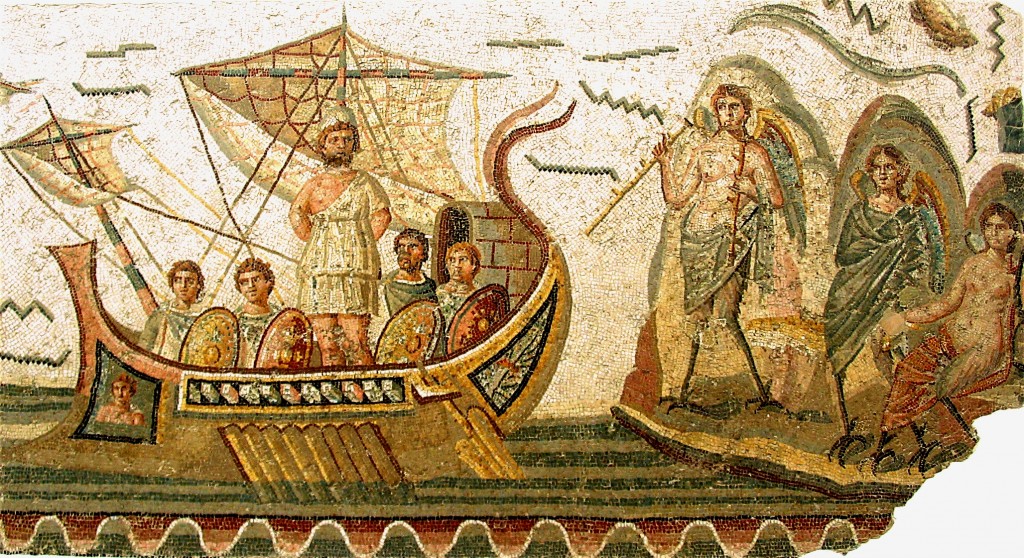
A Roman mosaic portraying the Odyssey. Its story was known to everyone — literally thousands of murals, mosaics and painted pottery vessels portraying it have survived, a tiny fraction of those that once existed.
It’s not clear how much of the Odyssey can connect with a modern reader. The motives, values and behaviours are, after all, those of the ancient world, and these overlap, but are not congruent with those of today. The Renaissance and especially the Enlightenment reading audiences were much more interested in Telemachus’ role than in Odysseus’ monsters and dalliances. It is not at all obvious to the modern reader why Telemachus was seen by Voltaire and Thomas Jefferson as a symbol of liberty and reason, enshrined in Fénelon’s Les aventures de Télémaque (1699), which earned its author political exile. In the tumultuous 18th Century, there were operas about Telemachus by Scarlatti, Gluck, Destouche, Sor, Gazzaniga, Le Sueur and Mayr.. far more than there were about Odysseus. Gluck’s Telemaco is still widely performed. But the 19th Century saw little of interest in either Telemachus or Odysseus, and despite the prestige of Homer, an attitude settled in that the Odyssey was an embarrassing vulgar commercial work that Homer must have ground out for the plebs to pay the rent while perfecting the higher-prestige Iliad ― or better yet that he didn’t write at all. So it was the Odyssey for the kiddies and the Iliad for the adults. Only James Joyce, so it seems, thought otherwise. This was quite logical in an age when “serious” was equated with “realist” and prestige literature was not supposed to have monsters in it. Half the best books of the 20th Century were ignored under the influence of that premise. The 21st Century has seen a renewal of interest in the Odyssey, along with all forms of imaginative, non-realist literature.
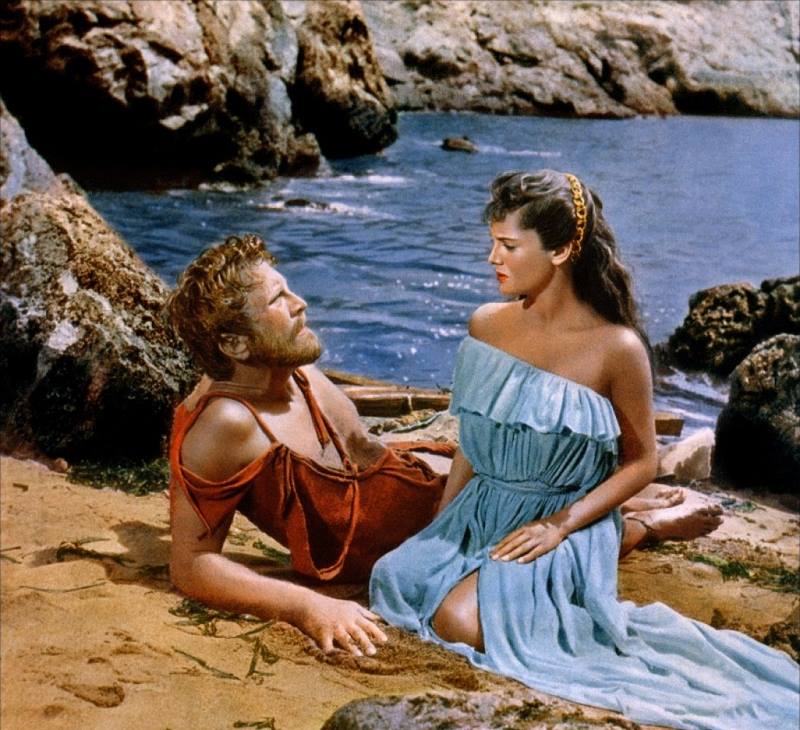
Kirk Douglas & Rossana Podestà in Ulysses (1954)
As well as rereading the great epic, I also indulged in viewing some of its cinematic interpretations. First, I watched the Italian-made Ulysses [Ulisse (1954) d. Mario Camerini], with most of the minor roles dubbed, but the parts of Kirk Douglas and Anthony Quinn acted in English. Silvana Mangana appears as both Circe and Penelope. Telemachus is played by Franco Interlenghi, who is little known outside of Italy, but began a prolific film career at age 15 in Vittorio De Sica’s Sciuscià, and for years rivaled Marcello Mastrioanni as a romantic lead. Rossana Podestà is a sexy Nausicaa. Douglas’ usually annoying smirk is well suited to a Wily Ulysses [Odysseus], and he does quite a good job. The script doesn’t stray far from the original, though it selects a few segments to concentrate on and omits some others. The Cyclops devouring Greeks scene is pretty graphic for the 1950s. Next, I saw the 1997 television miniseries The Odyssey starring Armand Assante, who portrays Odysseus as not so much wily as grumpy. The series is littered with celebrity walk-ons: Isabella Rossellini, Eric Roberts, Irene Papas, Geraldine Chaplin, Christopher Lee, some of which are rather strange casting, e.g. Bernadette Peters as Circe, and Michael J. Pollard as Aeolus (!) As with the 1954 version, this miniseries is reasonably faithful to the original. The same cannot be said for Odysseus: Voyage to the Underworld (2008, d. Terry Ingram), a Romania/Canada/UK co-production filmed in Canada. It bills itself as ” the tale Homer felt was too horrific to tell; the missing book of The Odyssey”. Yup. There is also a long French miniseries from 2013 that I haven’t been able to find.
First Meditation on Dictatorship [written Thursday, February 7, 2008] REPUBLISHED
Posted by Phil Paine
on September 10, 2018
No comments
 In the beginning years of this blog, I published a series of articles called “Meditations on Democracy and Dictatorship” which are still regularly read today, and have had some influence. They still elicit inquiries from remote corners of the globe. They are now buried in the back pages of the blog, so I’m moving them up the chronological counter so they can have another round of visibility, especially (I hope) with younger readers. I am re-posting them in their original sequence over part of 2018. Some references in these “meditations” will date them to 2007–2008, when they were written. But I will leave them un-retouched, though I may occasionally append some retrospective notes. Mostly, they deal with abstract issues that do not need updating.

Monument at Lidice.
The faces of the children are not generalized abstractions. They are carefully reconstructed from photographs to represent the individual children as they were in life.
We are so hamyd,
For-taxed and ramyd,
By these gentlery-men!
― The Wakefield Second Shepherds’ Play, c.1425–1450 [1]
We are men the same as they are:
Our members are as straight as theirs are,
Our bodies stand as high from the ground,
The pain we suffer’s as profound.
Our only need is courage now,
To pledge ourselves by solemn vow,
Our goods and persons to defend,
And stay together to this end…
— Robert Wace, Le roman de la Rou et des ducs de Normandie, 1160–70s [2]
On my return to Prague, last year, after tramping in Hungary and Transylvania, my friend Filip Marek took a day off for some more explorations of the Bohemian countryside. This turned out to be the most emotionally charged day in my travels, and I’ve delayed describing it because of its personal importance to me.
The landscape around Prague is not much different, at first glance, from that of Southern Ontario. It’s rich farmland, gently rolling hills, and patches of mixed forest similar to those around Toronto. Most of it was so pleasant that I couldn’t help replaying snatches of Dvořák, Smetana and Janáček in my head as the car rolled under the dappled sunlit trees, past fields and villages that seem to be both ancient and brand new at the same time. However, our quest was to extract something incongruously disturbing and tragic from Bohemia’s woods and streams.[3] We were going to see two places that do not loom large in the history books, but loom large in the kind of history that I am concerned with. The first was the Vojna Hard Labour Camp, in the forest near the village of Příbram, and the second was the site of Lidice, a village that no longer exists. Read more »
Image of the month: Lilies of the Amazon
Posted by Phil Paine
on September 1, 2018
No comments
 Nymphaea victoria amazonica, an extraordinary species of water lily found in shallow bayous and side-channels of the Amazon River, most of all in its immense delta. The floating leaf-pads may exceed 3 meters in width.
FILMS – AUGUST 2018
Posted by Phil Paine
on August 31, 2018
No comments
(Salkow 1940) The Lone Wolf Strikes
(Hellings 1985) Doctor Who: Ep.631 ― The Mark of Rani, Part 1
(Hellings 1985) Doctor Who: Ep.632 ― The Mark of Rani, Part 2
(Honda 1966) Frankenstein Conquers the World [aka Frankenstein vs. Baragon]
(Tenold 2018) Brandon’s Cult Movie Reviews: Frankenstein Conquers the World
(Bridge 2015) How the Universe Works: Ep.28 ― Monster Black Hole
(Moffatt 1985) Doctor Who: Ep.633 ― The Two Doctors, Part 1
(Moffatt 1985) Doctor Who: Ep.634 ― The Two Doctors, Part 2
(Moffatt 1985) Doctor Who: Ep.635 ― The Two Doctors, Part 3
(Giancola 1994) Time Chasers [Mystery Science Theatre Version]
Read more »
First-time listening for August 2018
Posted by Phil Paine
on August 31, 2018
No comments
25172. (Giovanni Bononcini) Astarto [complete opera; d. Biondi; Valentini, dalle Molle,
. . . . . Müller-Molinari]
25173. (Wale [Olubowale Victor Akintimehin]) Ambition
25174. (Brian Ferry) These Foolish Things
25175. (Johann Sebastian Bach) Cantata #80a “Alles, was von Gott geboren” [variant of #80]
Read more »
READING – AUGUST 2018
Posted by Phil Paine
on August 31, 2018
No comments
23962. (Homer) The Odyssey [tr. Stephen Mitchell] [previously read at 4398 in Rieu trans.]
23963. (Miljana Radivojević, et al) The Provenance, Use, and Circulation of Metals in the
. . . . . European Bronze Age: The State of the Debate [article]
23964. (James Blinkhorn & M. Grove) Structure of the Middle Stone Age in Easter Africa
. . . . . [article] [d]
23965. (Sheila McCullagh) Tom Cat and the Wideawake Mice
Read more »
(Richardson 1962) The Loneliness of the Long Distance Runner
Posted by Phil Paine
on August 16, 2018
No comments
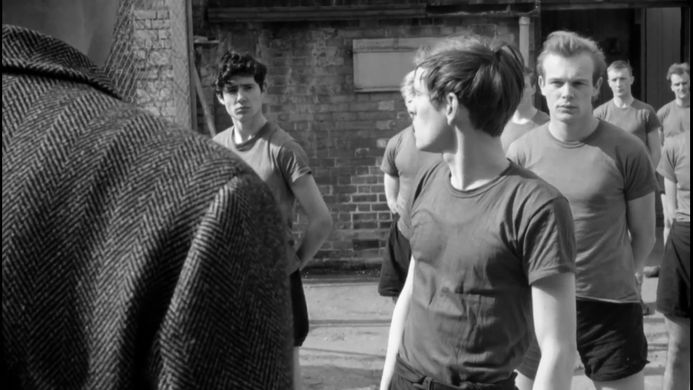
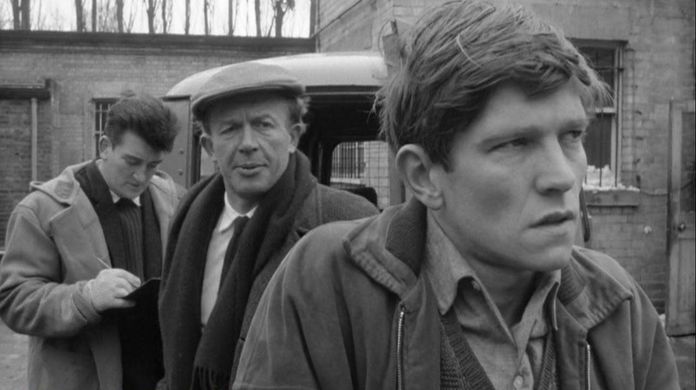
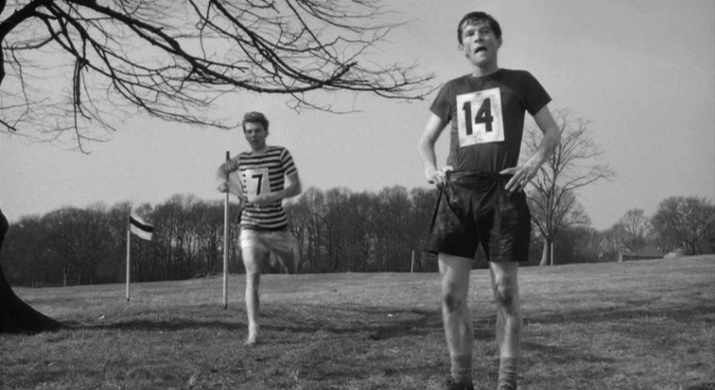
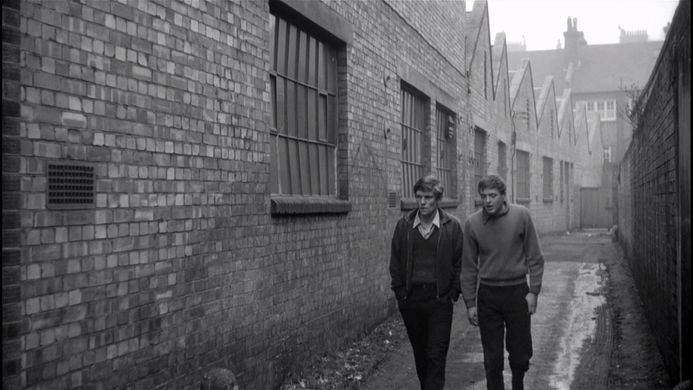
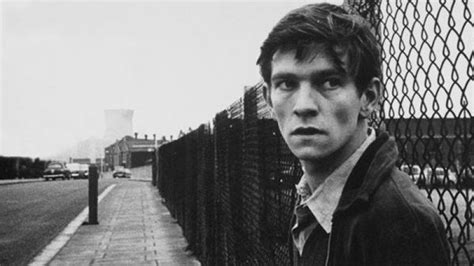 There is more to this bleak story of a young man in a juvenile detention facility than just another bit of “social realism” or the usual formula of redemption-through-sport. There are layers and layers in Alan Sillitoe’s story, and Ralph Richardson’s film gets many of them across. It’s about being controlled, being used, being forced to play roles for others, and finally rebelling against it in a way that makes some sense. The actors clearly understood these subtleties, and avoided clichés in interpreting the roles. Tom Courtney became a star on the strength of this performance. Michael Redgrave, by then a venerable icon, worked every scene with him in delicate balance. This film still has a high reputation in the British cinema, and justly so.