Tens of thousands of people in Hong Kong protest against attempts of the Communist Party to crush democracy in Hong Kong. “The students are protecting the right to vote, for Hong Kong’s future. We are not scared, we are not frightened, we just fight for it,” [Carol Chan, a 55-year-old civil service worker who said she took two days off to join the protests after becoming angered over police use of tear gas Sunday, quoted by CBC News.] Beijing’s massive censorship team on Weibo, the Party-controlled censored internet engine created and supplied by American corporations, is working overtime preventing the people of China from seeing such images. Read more »
Monday, September 29, 2014 — Two Pictures That Speak for Themselves
Posted by Phil Paine
on September 29, 2014
No comments
Sunday, September 28, 2014 — The Koch Suckers
Posted by Phil Paine
on September 28, 2014
No comments
Charles and David Koch are the multi-multi-billionaires who currently exercise strategic control over the Republican Party in the United States, and, through a vast, labyrinthine network of foundations and dummy corporations (known to journalists as the “Kochtopus”), control the Tea Party movement, most of the key Conservative think tanks, and the phony “Libertarian” movement. Canadians have as much to fear from the Koch brothers as Americans do. They have long been the principal consumers of Canadian “dirty oil.” Their Pine Bend, Minnesota facilities pipe it in to produce petcoke, a nasty polluter that is illegal in the United States, then sell it to the Communist Party in Beijing. They have quietly acquired leases for 1.1 million acres of Alberta oil fields and have nearly double the direct holdings that ExxonMobil has. In May, Koch Oil Sands Operation of Calgary sought permits to embark on a multi-billion-dollar tar sands extraction operation. [1] Read more »
Friday, September 19, 2014 — An Interesting Thought from Mark Thoma
Posted by Phil Paine
on September 19, 2014
No comments
It’s become a cliché that this generation of macroeconomists have withdrawn from the actual world and embedded themselves in a cocoon. You can get a Nobel Prize in Economics for dreaming up an equation that doesn’t have to be tested against real events in actual economies. (How the physicists, who must wait patiently for confirmation from reality, must envy them.) Too much emphasis on methodology, is the usual conclusion. But Mark Thoma, in the Fiscal Times has something to say about that:
“There has been quite a bit of criticism directed at the tools and techniques that macroeconomists use, e.g. criticism of dynamic stochastic general equilibrium (DSGE) models, but that criticism is misplaced. The tools and techniques that macroeconomists use are developed to answer specific questions. If we ask the right questions, then we will find the tools and techniques needed to answer them. The problem with macroeconomics is not that it has become overly mathematical – it is not the tools and techniques we use to answer questions. The problem is the sociology within the economics profession that prevents some questions from being asked. Why, for example, were the very questions we needed to ask prior to the Great Recession ridiculed by important voices within the profession? The key to a better economics is to ask better questions, and that will require a much more open mind – particularly from those in charge of what gets published in economic journals – about the kinds of questions economists are allowed to ask.”
This is an interpretation that would be understood by someone in the natural sciences (e.g. geophysics, or epidemiology, or climatology.) Asking the right questions is the key. Thoma asks why these questions were actively discouraged. He knows the answer, but leaves us to connect the dots. It was the result of a profession being hijacked by an aggressive ideology bent on suppressing real inquiry, and substituting a kind of Lysenkoist agenda. It was made possible by a revamped system in which the principles of academic autonomy and objective inquiry have become mere ectoplasmic traces. Macroeconomists who did ask the right questions didn’t seem to get far in academic careers, or end up in the cushy circumstances that more “co-operative” ones did. Or rather, that’s the case in the core, but not necessarily in the periphery. The serious questioning tends to take place in second-tier universities, where the moose or the wallabies nibble the shrubbery around the quadrangle. All the more power to ’em, I say. Lysenko’s ghost can’t patrol them all.
There has been quite a bit of criticism directed at the tools and techniques that macroeconomists use, e.g. criticism of dynamic stochastic general equilibrium (DSGE) models, but that criticism is misplaced. The tools and techniques that macroeconomists use are developed to answer specific questions. If we ask the right questions, then we will find the tools and techniques needed to answer them.
The problem with macroeconomics is not that it has become overly mathematical – it is not the tools and techniques we use to answer questions. The problem is the sociology within the economics profession that prevents some questions from being asked. Why, for example, were the very questions we needed to ask prior to the Great Recession ridiculed by important voices within the profession?
The key to a better economics is to ask better questions, and that will require a much more open mind – particularly from those in charge of what gets published in economic journals – about the kinds of questions economists are allowed to ask.
- See more at: http://www.thefiscaltimes.com/Columns/2014/09/16/Can-New-Economic-Thinking-Solve-Next-Crisis#sthash.LiClsQFW.dpuf
Thursday, September 18, 2014 — Romancing the Volcano
Posted by Phil Paine
on September 18, 2014
No comments
I can’t help it. I’ve fallen in love with a volcano. It’s so damn beautiful. Here is a video from Feel Iceland TV. In the plane are Haukur Snorrason, photographer & his son (un-named), and reporter Lára Ómarsdóttir. The music is by Jónas Haraldsson. Note on scale: the lava field shown is the size of Manhattan.
Two Excellent Historical Novels by V. M. Whitworth
Posted by Phil Paine
on September 14, 2014
No comments
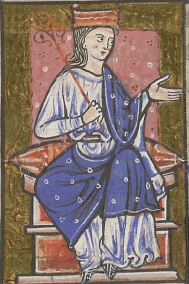
Æthelflæd as depicted in the cartulary of Abingdon Abbey
V. M. Whitworth’s The Bone Thief (Ebury, 2012), and it’s sequel The Traitor’s Pit (Ebury, 2013) are exemplary historical novels. The author is known, by another name, as a medieval historian. I read the first book merely out of curiosity, because I knew her scholarly work. But, after a few pages, I was hooked. The setting is England Before England Was, the reigns of Æthelred, King of Mercia and Edward of Wessex, who was soon to unify the two kingdoms and make considerable inroads on the Danelaw. The future England has long been split between Pagan and Christian kings, but the Norse Gods are fading as the Scandinavian conquerors are adopting Christianity (with varying degrees of sincerity), and the two cultures are merging. The action of the first book is inspired by an incident recorded in the Anglo-Saxon Chronicle as occurring in the year 909. The fictional hero is Wulfgar, a young cleric in the service of historical Æthelflæd, who is one of the more interesting women known from the period. For years, Æthelred has been too ill to rule, and The Lady of the Mercians rules in his stead. In The Bone Thief, she sends Wulfgar on a secret mission into the Viking-controlled Five Burroughs, to obtain the bones of St. Oswald, which she hopes will rally people to the Mercian cause. The bones have been lost, but are buried anonymously behind Bardney Abbey (which in 2014 is nothing more than a few stony lumps in a field northwest of the village of Bardney — see image below). Wulfgar is a timid soul, and is soon overwhelmed by the conspiracies, treacheries, and brutality of royal power politics. He has been chosen for the task primarily because he speaks some Danish. No adventure-seeker, he has a naïve belief in most of the things he was taught, which others around him regard as useful fictions or disposable formalities. In the sequel, he is assigned yet another mission, while at the same time trying to prove the innocence of his elder brother, who has been charged with participating in an attempt on the life of Edward. This leads into even more convoluted politics, violence, and tragedy. In both books, Wulfgar is constantly menaced by his nemesis, a bullying and brutal half-brother, and constantly aided by a fierce and roguish Dano-English female adventurer. Read more »
Friday, September 12, 2014 — Bárðarbunga Walk
Posted by Phil Paine
on September 12, 2014
No comments
Yes, some people actually do walk away from an explosion without looking back.…
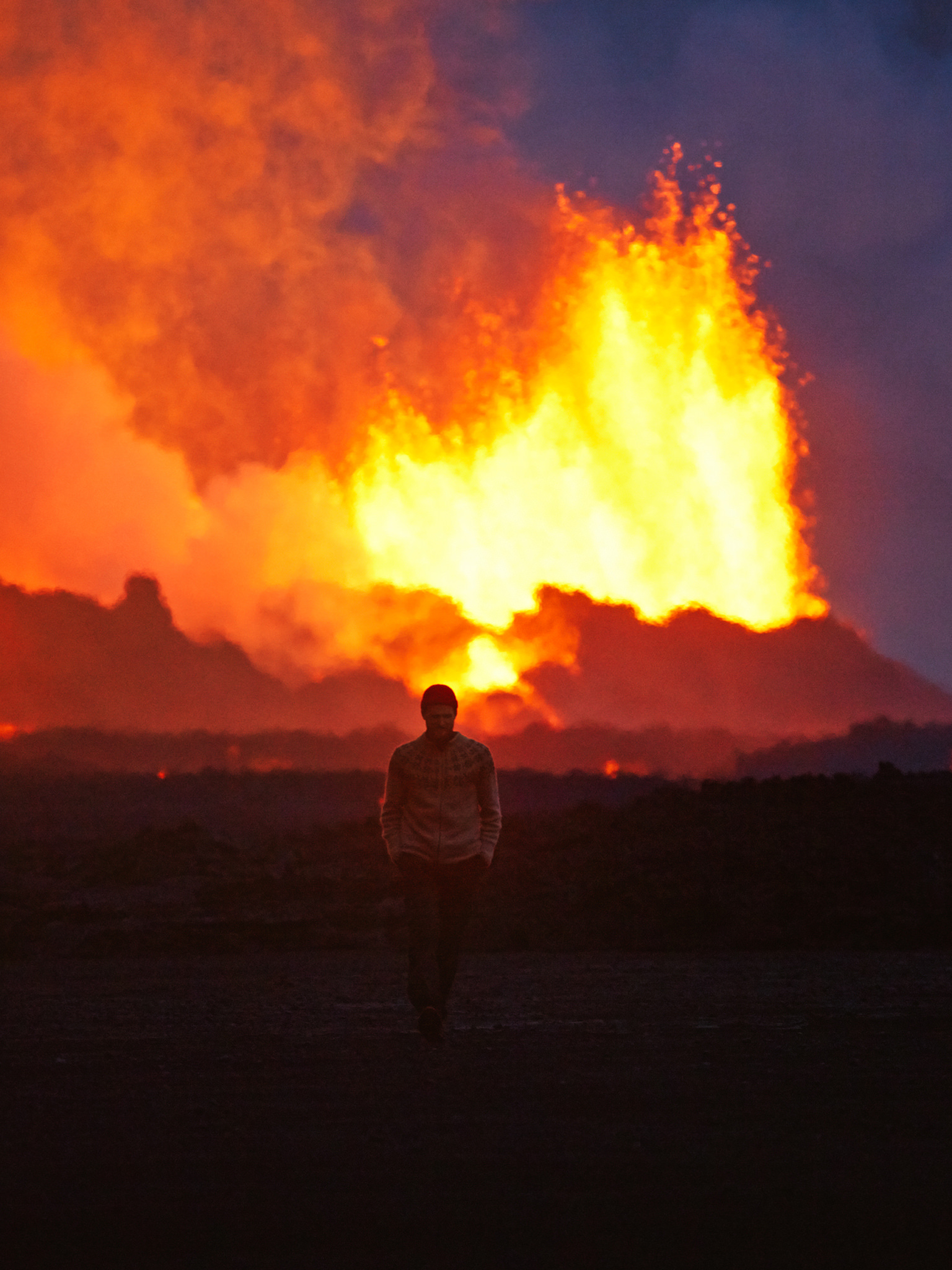 An Icelandic vulcanologist is obviously fed up with Bárðarbunga’s temper tantrums. Those lava plumes are higher than most city skyscrapers.
A landscape I walked on a few years ago no longer exists. Yesterday, sulphur dioxide levels peaked at 2600μg/m3 (significantly dangerous) at Reyðarfjörður, a fishing town on the east coast. When the lava flow reaches a small mountain called Vaðalda, its path will narrow, with unpredictable results. The Skínandi waterfall, a landmark, appears to be doomed. The worst danger remains possible: a jökulhlaup, or massive outburst of glacial melt, accompanied by toxic ash clouds
Photos by Axel Sigurðsson / Morgunblaðið. Read more »
Wednesday, September 10, 2014 — Ideologies
Posted by Phil Paine
on September 10, 2014
No comments

Ideology at work.
This is a teenager who was walking to school when he was nearly incinerated by a car-bomb planted by some ideologically-driven zombie. I know what the particular “cause” was, the particular faction, but I won’t bother to tell you because it doesn’t matter. This is what ideology is all about. Any ideology. Read more »
FILMS – AUGUST 2014
Posted by Phil Paine
on August 31, 2014
No comments
(Lemont 1961) Konga
(Neumann 1950) Rocketship X‑M [Mystery Science Theatre version]
(Tarkovsky 1960) The Steamroller and the Violin [Каток и скрипка]
(Traucki 2013) The Jungle
(Davies 1980) Madonna and Child
(Cox 2006) Mammoth
(Carstairs 1954) One Good Turn Read more »
First-time listening for August 2014
Posted by Phil Paine
on August 31, 2014
No comments
23002. (Cocteau Twins) BBC Sessions
23003. (Armens) Six différents
23004. (London Grammar) If You Wait
23005. (Johannes Ockegham) Virelai: “Ma bouche rit”
Read more »