The Song of the Scarlet Flower
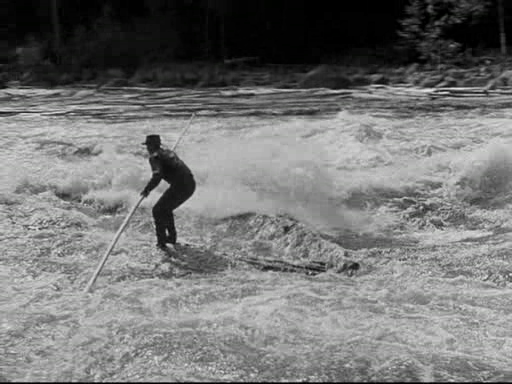
Before the process was mechanized, the logs taken from the great forests of northeastern North America were cut in winter, then dragged by horse teams to the shores of rivers. This method is still used in Nova Scotia to safeguard some environmentally sensitive forests, since it is far less destructive and more sustainable than clear-cutting. When the spring thaw came, the logs were driven down the rivers in great masses. Left to themselves, the logs would jam, and millions of board feet of lumber could back up for miles. So the logs had to be carefully herded down the rivers, like cattle. That’s why professional log driverswere needed. No cowboy ever worked a job as difficult and dangerous as the log driver. He danced across the floating logs on foot, balancing himself with his pike pole, skipping from bateau to rolling log, to rock, to log jam, like a ballet dancer. The job required a sort of instinctive grasp of physics, magical dexterity, and superhuman strength. The log driver is a standard character in Canadian folklore, celebrated in murals, currency, stamps, and in the classic folksong The Log Driver’s Waltz(because of his nimble footwork, “a log driver’s waltz pleases girls completely”). The French-Irish-Ojibway Canadians who dominated this profession faced little competition from anyone else. Not surprisingly, the key technical terms of the trade were either French or Ojibway (e.g. “wannigan”, the floating supply shack on a timber raft, from Ojibway wannikanoriginally meaning “storage pit”). But one group of immigrants to Canada did make their mark in this profession: the Finns. The Finns in North-western Ontario were not just bush lumberjacks. They boasted log drivers as skillful as their older Canadian rivals on the Saguenay and Ottawa drives.
Which brings me, in a roundabout way, to this film. The reason that Finns could be competitive log drivers in Canada is that the identical profession existed in Finland*, and it is the subject of the oldest Finnish motion picture in my film collection, Laulu tulipunaisesta kukasta(1938) [“The Song of the Scarlet Flower”]. It is not a cinematic masterpiece. The acting is melodramatic, the cutting sometimes awkward, and much of it feels more like a silent film of twenty years before. But it’s director, Teuvo Tulio, had great talent. The film’s enthusiasm and sincerity make up for what it lacks in sophistication. The story is based on a novel by Johannes Linnankoski, and follows the life of a young man who skips from girl to girl as easily as he skips from log to log, until his sinfulness catches up to him and forces him into spiritual redemption. All very pietist. A French Canadian version of this story wouldn’t bother with the redemption part, or for that matter see where there was any “sin” to redeem. I haven’t read the novel, so I don’t know if it is a faithful adaptation, or what elements are Tulio’s rather than Linnankoski’s. The book had already been filmed twice in a 1919 silent version, and in Swedish by Per-Axel Branner in 1934. It would be remade yet again in 1956. I don’t think any of these versions found an audience outside of Finland and Scandinavia. 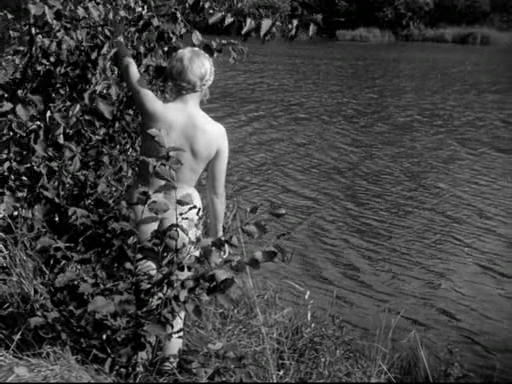
As always with old films, I watch partly just to see visual details of the past and other places. The film gives no hint of the devastating war that Finland would have thrust upon it only a year after its release. The country people play a rather strange version of the game of “tag”. The interiors of the squared log houses are spartan, but nevertheless already display the Finnish knack for fluid design. The kitchens look particularly nice. And, in a wild river landscape indistinguishable from frontier Quebec or Ontario, the log drive flows under one of those super-modern bridges that Finns were building in the 1930’s. The effect is disconcerting, as if someone had crudely photo-shopped the film with a modern snap.
The love scenes are far more sensuous than anything that would have been permitted in American cinema in 1938. There is an absolutely delightful nude scene. But the best parts of the film are the log driving scenes, which are both genuinely exciting and technically accurate.
———
— - — *searching for information on the subject, I came across this quote from Finnish film-maker Markku Varjola: “In the Finnish consciousness the logger occupies the role of the cowboy from the American heritage. He has represented adventure, freedom and independence, constantly moving true man, a vanishing breed.”, a sentiment that could just as easily have been written in Canada.