(Capilla Flamenca) The A‑La-Mi-Re Manuscripts:
. . . 22662. (Matthias Gascogne) Missa Myn hert: Kyrie
. . . 22663. (Jean Mouton) Celeste beneficium Read more »
First-time listening for February, 2011
Posted by Phil Paine
on February 28, 2011
No comments
READING – FEBRUARY 2011
Posted by Phil Paine
on February 28, 2011
No comments
19364. (George MacDonald Fraser) Flashman
19365. (Kenneth Pomeranz) The Making of a Hinterland ― State, Society, and Economy in
. . . . . . Inland North China, 1853–1937
19366. (Anthony H. Birch) The Concepts & Theories of Modern Democracy Read more »
Dvořak’s “American” Quartet No. 12 in F, Op. 96, B. 179
Posted by Phil Paine
on February 4, 2011
No comments
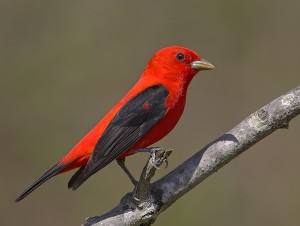
A Scarlet Tanager
I love string quartets. Composers seem to put their hearts and minds into them in a way that they don’t reliably do for other forms. Since they have little commercial value, they are usually composed with nobody looking over the composer’s shoulder, and no box-office considerations. The stark simplicity of the combination of two violins, viola, and cello, which nevertheless allows for a full tonal range and the interplay of individual and combined voices, attracts the composer who wants to put across serious thoughts.
Antonín Dvořak wrote fourteen string quartets, but the twelfth, nicknamed “American”, is by far the most popular and moving. It has a sweetness of melody and an inventiveness, from moment to moment, that links it with his wonderful “New World” symphony. It was, in fact, written at the same time, while Dvořak was visiting a small town in Iowa (settled by Bohemian and Moravian immigrants). It’s easy to find the influence of African-American spirituals in it, while its Czech elements are just as solid. The first violin motif in the third movement echoes the song of the scarlet tanager, a bird he heard often in Iowa. Like the popular ninth symphony, it’s a profoundly humanistic and optimistic work. This was the happiest time in Dvořak’s life, and he was by nature a gentle and compassionate man. Those elements infuse the work, which was written, as I understand, mostly outdoors, on the banks of a stream near an Iowa farm. This spot must have been, for him, simultaneously the pioneer-broken prairies of a “new world”, and the left bank of the Vltava at Nelahozeves. Comforting tradition and wild freedom, age and youth, wisdom and innocence all combined, without conflict, without contradiction. When I feel that things are basically all right in the universe, that the forces of darkness must in the long run be overtaken by the light, then this is the music for me.

FILMS – JANUARY 2011
Posted by Phil Paine
on January 31, 2011
No comments
(Grauba 2007) Defenders of Riga [Rigas sargi]
(Amenábar 2009) Agora
(Lester 1973) The Three Musketeers
(Fosse 1972) Cabaret Read more »
First-time listening for January, 2011
Posted by Phil Paine
on January 31, 2011
No comments
22648. (Audioslave) Revelations
22649. (Rolling Stones) 12 X 5
22650. (Piirpauke) Piirpauke 2 Read more »
READING – JANUARY 2011
Posted by Phil Paine
on January 31, 2011
No comments
19320. (Jules Verne) Cinq Semaines en ballon
19321. (Steve Muhlberger) [in blog Muhlberger’s Early History] Agora (2009) [film review]
19322. (Francis Spufford) Red Plenty Read more »
Ordering The Secret History of Democracy online
Posted by Phil Paine
on January 17, 2011
No comments

It’s a bit pricey for most people I know, but if you’re in a position to recommend it to a library, faculty, or institution, do so. In addition to chapters by myself and old friend Steven Muhlberger, the contributors are Benjamin Isakhan, Stephen Stockwell, John Keane, Larissa Behrendt, Pauline Keating, Mohamad Abdalla & Halim Rane, Patricia Pires Boulhosa, Luisa Gandolfo, I.Kissa, and P.Fry.
Pre-orders in Canada from Chapters-Indigo online (available April 12)
in the U.S.A from Amazon.comor Barnes & Noble(available April 12)
in the U.K. and Europe from Amazon.uk(available February 11)
in Australia from EmporiumBooks.com.au(available March 11)
“The thought-provoking essays gathered in The Secret History of Democracyprovide convincing evidence that democratic mechanisms have been invented many times and in many places, including times and places neglected in common accounts. This collection is a sobering reminder that democratic practices have often been succeeded by something else. But one also takes away a sense of the dynamic character of democratic history and the endless diversity of practices with some reasonable claim to embody democratic principles. As growing numbers wonder about what sorts of political institutions make sense in the face of the enormous problems confronting the twenty-first century, this demonstration of the long human history of political creativity gives some reason for hope.”
-John Markoff
“A fascinating, thought-provoking and well-informed survey of little-known “roots of democracy” and “proto-democratic” systems and movements across the globe , from ancient and “primitive” to modern societies. An eye-opener that forces us to differentiate more carefully and to rethink the history of democracy.”
- Kurt Raaflaub
“This exciting book surely enlivens and enriches our debate on democracy and its future by digging afresh oft-forgotten, yet most enlightening democratic experiences found in human history. ”
- Takashi Inoguchi
Image of the month: Jean Sibelius
Posted by Phil Paine
on January 1, 2011
No comments
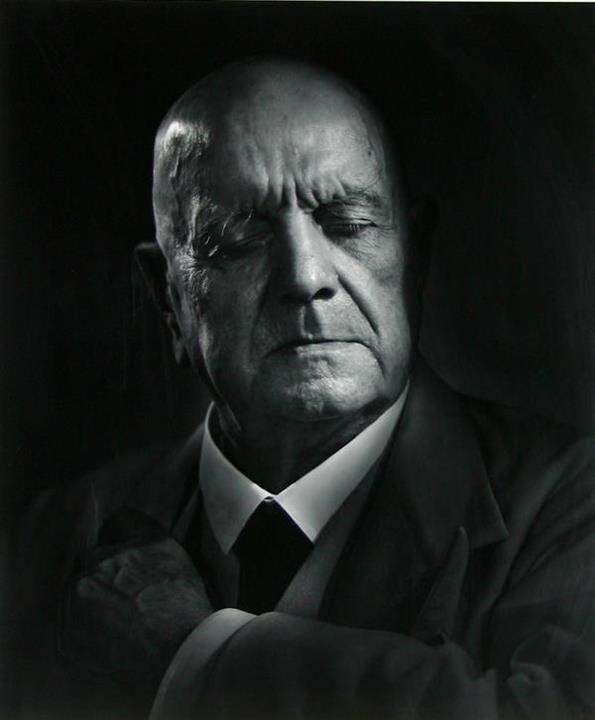
Jean Sibelius has remained my favourite composer throughout my life. Something in his work touches me directly. One of my greatest pleasures was to attend the unique concert series in which all his symphonies were performed (for the first time) in sequence, under the direction of the young and brilliant conductor Thomas Dausgaard. When I told him, during the post-performance reception, that it was the best performance of the 4th symphony (my favourite) I had ever heard, he replied that it was his favourite as well.. giving much the same reasons I would have. It is the most difficult, and perhaps the least played of the seven symphonies.… dark, ambiguous, complex, and intriguing.
This photograph is by Jousuf Karsh, the Canadian portrait photographer who made iconic images of Winston Churchill, Ernest Hemmingway, and many others. Karsh remembered details of the sitting:
“I arrived at Sibelius’s home ‘Ainola,’ named for his wife Aino, laden with gifts from his admirers — an inscribed manuscript from composer Ralph Vaughan Williams, a warm letter from Olin Downes, the celebrated music critic of the New York Times, a box of his favorite cigars and a bottle of old cognac from the Canadian High Commissioner in London. This last we shared with little Finnish cookies and coffee. His daughter interpreted for the straight-backed patriarch of eighty-four, although there was such a meeting of minds that words became scarcely necessary. The structure of his face reminded me of carved granite, yet with infinite warmth and humanity. This photograph was one of the last taken. He was visibly moved as I told him how the Finnish workers, in their northern Canadian logging camps, doubled their wartime output when his Finlandia was played for them.”
The links go to related articles on this blog. Some others:
The Kalevala, is the Finnish epic that inspired much of Sibelius’ music. A youthful work of his, Kullervo Op.7, is a choral-orchestral telling of part of the epic. I also discuss it here. En Saga, Op.9is another. I have also written blog items about his string quartets, and his first symphony.
FILMS OCTOBER-DECEMBER 2010
Posted by Phil Paine
on December 31, 2010
No comments
(Dixon 2006) Time Team: Ep.171 ― Special: Buried by the Blitz
(Docter & Peterson 2009) Up
(Reis 1947) The Bachelor and the Bobby-Soxer Read more »