22421. (Frank Jordans) Ancient Wheat Points to Stone Age Trading Links [article]
22422. (Xue-Bing Wu, et al) An Ultraluminous Quasar with a Twelve-billion-solar-mass
. . . . . Black Hole at Redshift 6.30 [article]
22423. (P. Skoglund, et al) Genomic Diversity and Admixture Differs for Stone-Age
. . . . . Scandinavian Foragers and Farmers [article]
Read more »
Category Archives: B - READING - Page 16
READING – APRIL 2015
Posted by Phil Paine
on April 30, 2015
No comments
READING – MARCH 2015
Posted by Phil Paine
on March 31, 2015
No comments
22416. (Dwayne Brown) Curiosity Rover Finds Active, Ancient Organic Chemistry on Mars
. . . . . [article]
22417. (Ben Krause-Kyora, et al) Use of Domestic Pigs by Mesolithic Hunter-Gatherers in
. . . . . Northwestern Europe [article]
22418. (Patrick Cockburn) The Destruction of Idols: Syria’s Patrimony at Risk from
. . . . . Extremists [article]
Read more »
READING – FEBRUARY 2015
Posted by Phil Paine
on February 28, 2015
No comments
22391. (Jacques Futrelle) The Problem of Cell 13 [story]
22392. (Andrew Armitage) Comparing the Policy of Aboriginal Assimilation: Australia,
. . . . . Canada, and New Zealand
22393. (Jean-Paul Gagnon) Democracy and Theoretical Physics [article]
22394. (Natalia Loukacheva) The Arctic Promise — Legal and Political Autonomy of
. . . . . Greenland and Nunavut
Read more »
READING – JANUARY 2015
Posted by Phil Paine
on January 31, 2015
No comments
22364. [3] (H. G. Wells) The Time Machine
22365. (H. G. Wells) The Chronic Argonauts [story]
22366. (Mark McCormack) The Declining Significance of Homophobia — How Teenage
. . . . . Boys are Redefining Masculinity and Heterosexuality
22367. (W. W. Jacobs) The Well [story]
Read more »
READING – DECEMBER 2014
Posted by Phil Paine
on December 31, 2014
No comments
22331. (Tim Flannery) The Final Frontier — An Ecological History of North America and Its
. . . . . Peoples
22332. (Victor L. Whitechurch) The Affair of the German Dispatch-Box [story]
22333. (Colin Newbury) Tahiti Nui — Change and Survival in French Polynesia 1767–1945
Read more »
READING – NOVEMBER 2014
Posted by Phil Paine
on November 30, 2014
No comments
22228. (Tiantian Zheng) Recasting Gender and Prophylactic Use in China: A Historical and
. . . . . Anthropoligical Perspective [article]
22229. (Joël Plouffe & Harry Borlase) L’Arctique de Stephen Harper
Read more »
READING – OCTOBER 2014
Posted by Phil Paine
on October 31, 2014
No comments
22131. (Henry Reynolds) A History of Tasmania
22132. (Maurice M. Durand & Nguyẽ̂n Trà̂n Huân) An Introduction to Vietnamese Literature
22133. (Soth Polin) Communicate, They Say [story]
22134. (Soth Polin) The Diabolic Sweetness of Pol Pot [article]
22135. (Sharon May) In the Shadow of Angkor: A Search for Cambodian Literature [article]
22136. (Kurt E. Dongoske) Ethics of Field Research for the Hopi Tribe [article]
Read more »
READING – SEPTEMBER 2014
Posted by Phil Paine
on September 30, 2014
No comments
22036. (V. M. Whitworth) The Traitor’s Pit
22037. (Judith Beyer) Ordering Ideals: Accomplishing Well-Being in a Kyrgyz Cooperative of
. . . . . Elders [article]
22038. (Kenneth J. Lavovara, et al) A Gigantic, Exceptionally Complete Titanosaurian
. . . . . Sauropod Dinosaur from Southern Patagonia, Argentina [article]
Read more »
Two Excellent Historical Novels by V. M. Whitworth
Posted by Phil Paine
on September 14, 2014
No comments
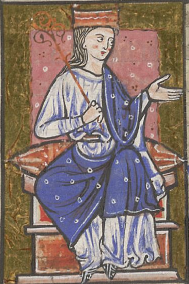
Æthelflæd as depicted in the cartulary of Abingdon Abbey
V. M. Whitworth’s The Bone Thief (Ebury, 2012), and it’s sequel The Traitor’s Pit (Ebury, 2013) are exemplary historical novels. The author is known, by another name, as a medieval historian. I read the first book merely out of curiosity, because I knew her scholarly work. But, after a few pages, I was hooked. The setting is England Before England Was, the reigns of Æthelred, King of Mercia and Edward of Wessex, who was soon to unify the two kingdoms and make considerable inroads on the Danelaw. The future England has long been split between Pagan and Christian kings, but the Norse Gods are fading as the Scandinavian conquerors are adopting Christianity (with varying degrees of sincerity), and the two cultures are merging. The action of the first book is inspired by an incident recorded in the Anglo-Saxon Chronicle as occurring in the year 909. The fictional hero is Wulfgar, a young cleric in the service of historical Æthelflæd, who is one of the more interesting women known from the period. For years, Æthelred has been too ill to rule, and The Lady of the Mercians rules in his stead. In The Bone Thief, she sends Wulfgar on a secret mission into the Viking-controlled Five Burroughs, to obtain the bones of St. Oswald, which she hopes will rally people to the Mercian cause. The bones have been lost, but are buried anonymously behind Bardney Abbey (which in 2014 is nothing more than a few stony lumps in a field northwest of the village of Bardney — see image below). Wulfgar is a timid soul, and is soon overwhelmed by the conspiracies, treacheries, and brutality of royal power politics. He has been chosen for the task primarily because he speaks some Danish. No adventure-seeker, he has a naïve belief in most of the things he was taught, which others around him regard as useful fictions or disposable formalities. In the sequel, he is assigned yet another mission, while at the same time trying to prove the innocence of his elder brother, who has been charged with participating in an attempt on the life of Edward. This leads into even more convoluted politics, violence, and tragedy. In both books, Wulfgar is constantly menaced by his nemesis, a bullying and brutal half-brother, and constantly aided by a fierce and roguish Dano-English female adventurer. Read more »