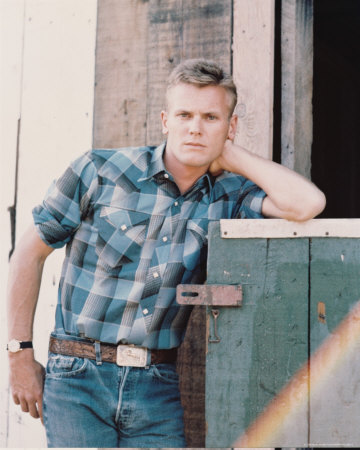
 I was surprised at how much I learned about how Hollywood works from this biography of a star of the 1950’s. Tab Hunter was a “heart-throb”, an actor who was marketed for his handsomeness. I frankly don’t find his kind of looks very attractive, but many people do. His autobiography is “co-authored”, probably meaning that Hunter was extensively interviewed, provided tape recorded reminiscences, and the “co-author” put it together in first-person voice. It’s a perfectly valid way for an actor, who doesn’t happen to be an experienced writer, to tell his story. In this case, the result seems to be unusually honest. Hunter stumbled into movie acting, and was initially successful because of his looks. He was gay, and went through the complexities, strategies, and perils that gay actors had to face in the 1950s. What it particularly charming about the narrative is the fact that Hunter (real name Arthur Andrew Kelm), who had an impoverished childhood in a rather disfunctional single-parent family, was in person a rather bashful, reticent, and psychologically conservative person, more comfortable with horses than people. His wholesome, boy-next-door image was not an act. However, he was able to attract people like Anthony Perkins and Rudolf Nureyev as lovers. He moved easily in sophisticated circles in the theatre, and in Europe’s high society, without altering his persona. His acting career has never been taken seriously, though he did some fine work on the stage and in television, and clearly cared deeply about his craft. He struggled to get roles that didn’t consist mostly of posing shirtless. But in the end, he was done in by cultural shifts that put his image out of fashion. His most intelligent career move was to appear in John Waters’ 1980 low budget cult film, Polyester. That, and publicly coming out of the closet, won him the respect he had never gotten as a teen idol. The book is not vindictive, but it gives a very believable account of some of the nastier things that went on in the film industry in the 1950’s and 1960’s.
Category Archives: B - READING - Page 43
14667. (Tab Hunter & Eddie Muller) Tab Hunter Confidential
14554. (Michel Tremblay) Quarante-quatre minutes, quarante-quatre secondes
 Michel Tremblay is a giant in Canadian literature, but anglophone readers are generally only familiar with his plays. Les Belles-Soeurs (“The Sisters-in-Law”) transformed french-language theatre in Canada. He was definitely a vanguard, writing vividly in a colloquial Canadian, and exploring new subject matter. Over the years, Tremblay built up a huge corpus of work, including many novels and television dramas in addition to the plays, a “comédie humaine” from the sinews of Montreal. Tremblay is an oddity, an openly gay author who is best known for his understanding of women. Satisfyingly complex roles for female actors are hard to find on the stage, and Tremblay has earned their gratitude and respect.
This is the first of his novels that I’ve read. The main character is a singer whose career stalled after a single album. The book focuses on the period in the early 1960s when Montreal’s music scene was especially vital. Félix Leclerc, Gilles Vigneault, Monique Leyrac, Clémence Desrochers, Claude Léveillée and others were creating fabulous songs, many of them with extraordinarily beautiful lyrics*. Tremblay interweaves history and fiction delicately. The prose style is very, very Canadian, anchored in real speech and real thought, without any affectations. The people are completely believable. The story is structured as an album: ten songs, ten situations, ten meditations on what might have been. It explores something hardly touched on by writers, the soul searching of a life that is neither tragic nor triumphant, but caught, like most of us are, somewhere in between. Read more »
14658. [2] (William Shakespeare) Henry V [play]
At first glance, Henry V seems to be one of Shakespeare’s simpler plays. It is often interpreted as straightforward patriotic propaganda. Laurence Olivier treated it more or less this way in his brilliant 1944 film version. But the play contains many elements that don’t fit into this interpretation. I’m more inclined to see it as a study of how a charismatic figure can delude others and himself, using various techniques of manipulation. Shakespeare was always aware of these techniques. Marc Antony’s speech to the plebs in Julius Caesar is practically a textbook on how to manipulate a crowd. Henry uses similar methods to keep his war in France rolling, and Shakespear ironically points out the end results for the ordinary men who are caught up in his ambitions. He does this very subtly, however. The play also contains the ancestor of all those American World War II movie scenes where the infantry platoon has a guy from Texas, a guy from Iowa, a guy from New England, and a guy from Brooklyn, each with his accent and comic shtick. In this case, it’s Gower (English), Fluellen (Welsh), Macmorris (Irish) and Jamy (Scottish) each playing out their ethnic stereotypes which, apparently, have remained unchanged for the last five hundred years.
14657. (Dan O’ Neill) The Firecracker Boys
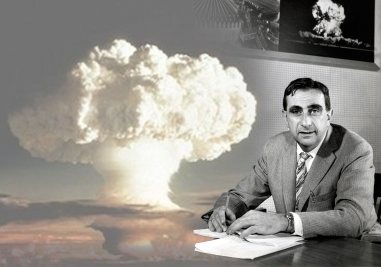
Edward Teller in a Lawrence-Livermore Labs publicity photo.
In 1958, the Atomic Energy Commission made a concerted effort to convince the citizens of Alaska to allow them to explode a series of nuclear weapons on the northwestern coast of that state. The effort was directed by Edward Teller, the “father of the hydrogen bomb”, who travelled to Alaska to promote the idea. Teller was a formidable opponent of the nuclear test ban treaty. President Eisenhower, already extremely distrustful of what he was already begining to think of as the “military-industrial complex” and experienced in the real politics of war, was not swayed against the treaty, but he was amenable to Teller’s claims that nuclear weapons could be used for peaceful purposes. The Alaska project was at first dubbed “Ploughshare” and then later changed to “Chariot”.
The project was to use nuclear weapons to excavate a huge harbour in a place where it had no conceivable economic utility, and where it would wreak spectacular destruction of both the ecosystem and the human community. It was promoted to the Alaskans with razzle-dazzle, constantly changing justification, and a landslide of bare-faced lies. Teller himself appears to have been an almost pathelogical liar. Alaskans were told the most fantastic and absurd things imaginable, any concoction of untruths and half-truths that would placate doubts or shut up opposition. Predictably, the local Chamber of Commerce types, the Press, and State legislators jumped on the bandwagon. Here is an example of the kind of thinking displayed by the Anchorage Times: “Asking Alaskans for a decision on this proposed atom experiment is like a doctor asking his patient whether he wants an operation. The easiest answer is ‘no’. The doctor usually tells the patient he must have one for his own good, and the patient does as the doctor says. The atom scientists are the doctor in this case. If they say that adequate safeguards for life and property have been provided, how can laymen say otherwise?” Wow, there’s some rugged individualism and critical journalism for you. Read more »
Tuesday, May 2, 2006 — Death of Jane Jacobs
 Jane Jacobs died last week. I did not always agree with her ideas, but I always had tremendous respect for her intellect and integrity. She was among the century’s most brilliant and original thinkers, and her presence alone made my city of Toronto an important intellectual center.
She was born in 1916, in Scranton Pennsylvania. Her first, and best-known book, The Death and Life of Great American Cities, was published while she still lived in New York City. It revolutionized thinking about urban planning and the nature of city neighbourhoods. But her subsequent books are equally important. They logically moved from the small scale questions she began to ask, such as “why is one street popular and safe, and another shunned and dangerous?”, through progressively larger issues of macro-economics, and finally to unexplored areas of ethics. She moved to Toronto, with her architect husband, in 1969, largely because of her opposition to the Vietnam War. Once in Toronto, she quickly became a public figure, spearheading opposition to urban policies that had already crippled many American cities. Thanks to her influence, Toronto avoided many of these disasters. Like any truly good thinker, she managed to be arrested at least twice, but she was never an enthusiast for the poses and pretenses of the professional “activist”. What she was good at was looking at the real world without the filter of ideological orthodoxy, and then writing down her common-sense conclusions with in a clear, simple style, more akin to the work of Montaigne than to the obscurantist fashions of her time. So it didn’t surprise me when I learned that, as a lonely child, she amused herself by carrying on imaginary conversations with Thomas Jefferson, Benjamin Franklin, and an Anglo-Saxon chieftain named Cerdric.
I first read her work when I was a teenager. One sentence of hers had a profound impact: “There is a quality even meaner than outright ugliness or disorder, and this meaner quality is the dishonest mask of pretended order, achieved by ignoring or suppressing the real order that is struggling to exist and to be served.” Remembering this sentenced saved me many times from being taken in by the waves of fake “rationalism”, pseudo-science, and mysticism masquerading as reason, that characterized the century I grew up in. John Sewell, the mayor of Toronto who actually took her ideas seriously, did not waste time explaining her writings, or their meaning. Instead, he spoke of her as a charming dinner companion, addicted to sweets (especially butter tarts), and relentlessly curious and questioning. Sewell was eventually ousted by an alliance of developers, corrupt police, and sleazy politicians, but in his term in office, Toronto blossomed, while other North American cities sank into decay and chaos. Many credit this positive era to her influence. The sad thing is that Jane’s struggle will go on in a new form. In all likelihood, her ideas will be oversimplified and grotesquely distorted, and used by some future generation to do harm. That is the most horrible thing about being an original thinker.
READING – APRIL 2006
(Dr. Seuss & Alexander Abingdon) The Omnibus Boners:
. . . . 14638. (Dr. Seuss & Alexander Abingdon) Boners, Being a Collection of Schoolboy
. . . . . . . . . Wisdom, or Knowledge as it is Sometimes Written, Compiled
. . . . . . . . . from Classrooms and Examination Papers by Alexander Abingdon &
. . . . . . . . . Illustrated by Dr. Seuss
14639. (Dr. Seuss & Alexander Abingdon) More Boners
14640. (Dr. Seuss & Alexander Abingdon) Still More Boners
14641. (Osamu Tezuka) Phoenix ― A Tale of the Future [graphic novel]
Read more »
14653. (Lili Réthi & William W. Jacobus) Manic 5: The Building of the Daniel Johnson Dam
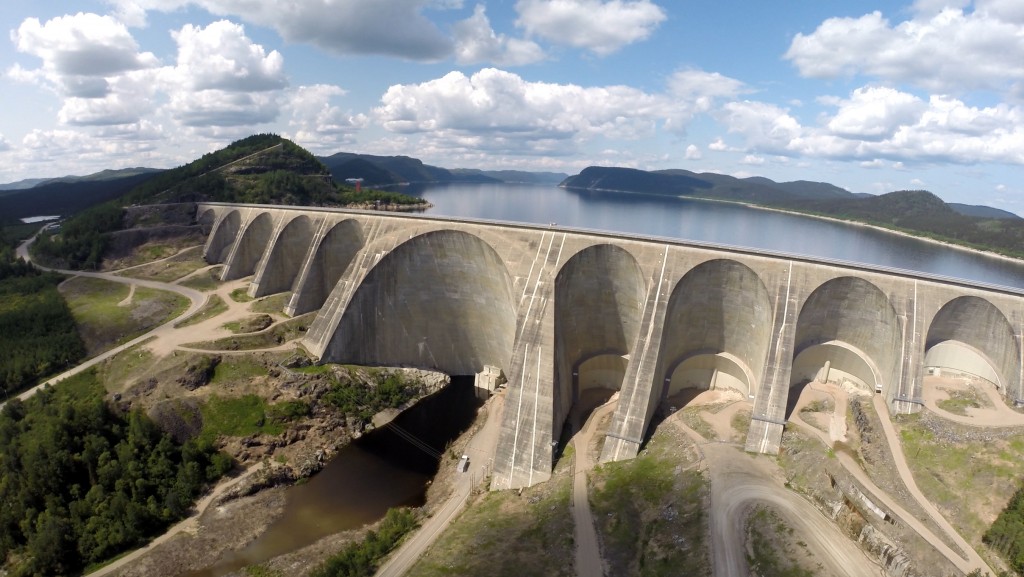
Giant hydro-electric dams are not exactly a popular subject, these days, but, ecological considerations aside, the building of Manic 5 certainly provides a heavy dose of awe and romance. Few tourists take the trouble to journey into the remote district in Northern Quebec where this huge structure is. It’s not just the gigantic statistics (even the 735,000-volt transmission lines were an engineering achievement on an unprecedented scale), but the human drama of its construction. The authors capture this in both prose and about a hundred beautiful drawings. Lili Réthi, who looked something like Miss Marple, was one of the greatest architectural and engineering artists, and she died shortly after completing the Manic 5 drawings. Her work, which is of great artistic value in my view, is known only to architects and engineers.
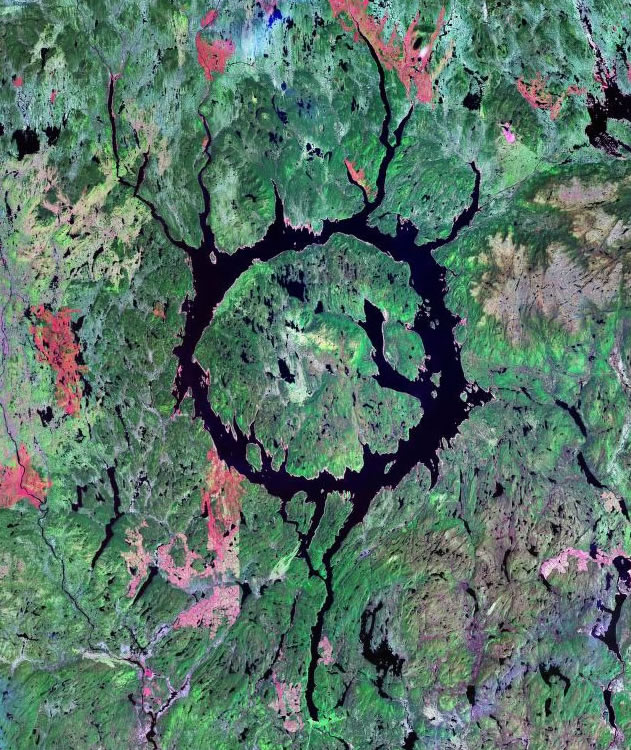
The reservoir created by Manic 5 is even more interesting than the dam. Anyone who has spent any time in Earth orbit is quite familiar with it, since it stands out like a bull’s‑eye, seen from space. The project flooded the impact crater created by a five km wide asteroid that struck Quebec towards the end of the Triassic. The Manicouagan lake acts as a giant hydraulic battery for Hydro-Quebec. In the peak period of the winter cold, the turbines are run all the time at peak load to meet the massive electrical heating needs of the province. During the summer, the surplus is sold to the New England grid. The island inside the lake is larger than Rhode Island. Some of the lakes within the island within the lake have large islands in them. As far as I know, there are no inhabitants.
14652. (Evangeline Walton) Prince of Annwn, the First Branch of the Mabinogion
The Mabinogion is a compilation of Welsh legend that we know from two medieval manuscripts, the Llyfr Gwyn Rhydderch (White Book of Rhydderch) and the Llyfr Coch Hergest (Red Book of Hergest). J. R. R. Tolkien was expert in these sources, and it’s not surprising that there are echoes of the Mabinogion in the Lord of the Rings. Evangeline Walton worked more directly with the Welsh material. Prince of Annwn is pretty much a retelling of the first tale, “Pwyll, Prince of Dyfed”. She attempts to strike a balance between the original mythic style of story-telling and modern novelistic techniques. The result is very satisfying. It doesn’t feel “modern”, but it satisfies the modern taste for narrative surprise and drama. Her vocabulary and phrasing are well chosen: she uses an “elevated”, poetic prose without sounding silly, a very difficult trick indeed.
I’ve read two different translations of the Mabinogion (the Ganz and the Jones & Jones versions), so I’m not sure how it comes across to someone who has never known the mythology. Walton stays reasonably close to the original, though she throws in a few unrelated bits from the Irish epics for dramatic purposes. Welsh mythology is as misty and disconcerting as the Welsh landscape: you can never tell what is supposed to be real or dream, natural or supernatural. I spent a week walking through the Welsh mountains, and I’m still not sure what actually happened to me and what I halucinated. Walton’s fantasy captures that feeling.
14645. (David R. Row) Executed on a Technicality
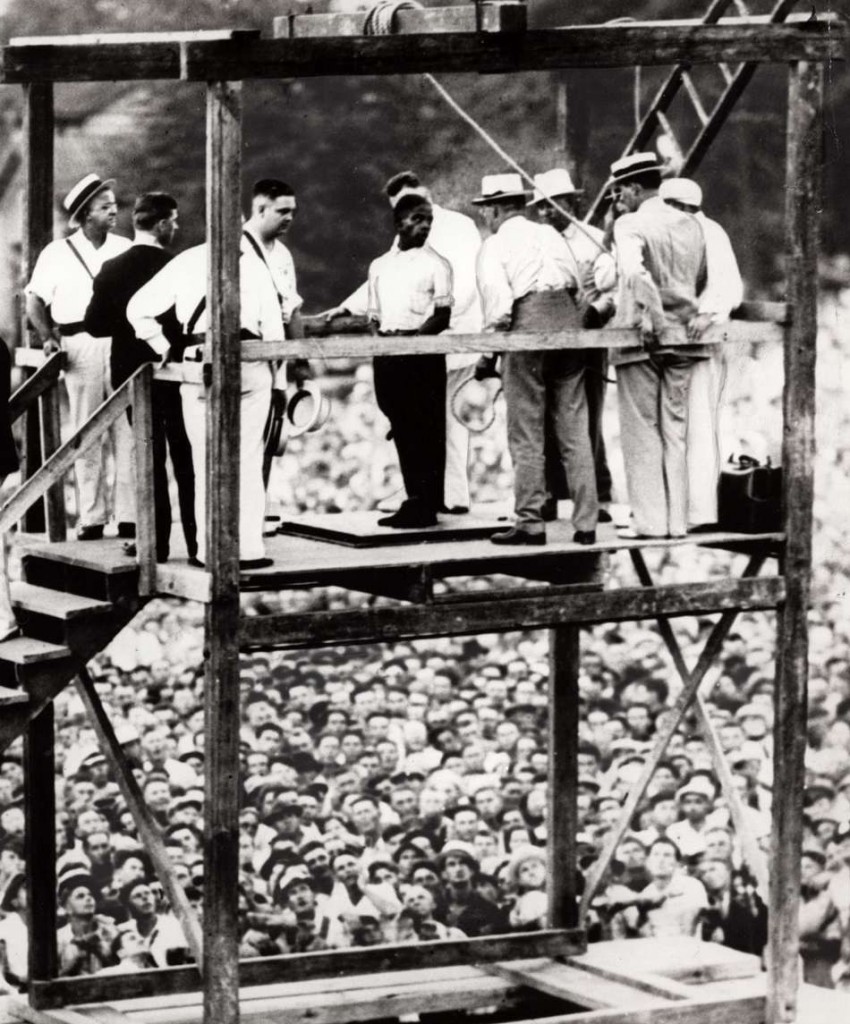
The last public hanging in the U.S., in Owensboro, Kentucky on June 7, 1936
David Row is a defense lawyer in Texas, the American State where the death penalty’s injustice and barbarism are most glaringly evident. The picture of Texas “justice” that he draws makes it clear that there is no more of a judicial system there than in any sleazy Communist dictatorship. Since 1996, the Conservative movement has launched a successful assault on the most fundamental principles of common law and liberty. Row is working from within the system, and within his society, so his approach to the subject seems rather timid to an outsider. In his universe, he is fighting an uphill battle, like a doctor trying to convince a primitive tribe that disease is caused by germs, not witch’s curses. For that is the real situation. Eighty percent of Americans are enthusiastic supporters of the death penalty, not because of any reasoned analysis, but because they are ignorant savages. They do it for the same reason that Aztecs ripped the hearts out of sacrificial victims and the Taliban executed women in football fields. It is in that kind of social environment that the Conservative agenda of destroying freedom and civilization can run rampant. To someone who lives outside this backward world (and outside the rampage of crime and senseless murders that it perpetuates), it is just embarrassing to read a book that shouldn’t have to be written.
14643. (Gwynne Dyer) With Every Mistake
Gwynne Dyer is a Canadian journalist (now based in the U.K.), and an expert on military subjects, who has had a globally syndicated column for many years. I don’t always agree with him, but he is competent, writes honestly, and doesn’t prevaricate. He’s generally a voice of common sense. Unfortunately, for the last decade, his column hasn’t appeared in very many Canadian newspapers. The majority of big Canadian papers have been under the control of the malignant press baron, Conrad Black, and his successor, in recent years. Dyer is persona non grata. This book contains a selection of the columns that most of us, here in his native land, have missed.
Dyer’s strong point is that, unlike most journalists, he knows how the military works, how decisions get made in it, and what war really involves. He also knows something about the culture and history of the world in general. This puts him way ahead of most journalists. He is weaker when trying to second-guess the motives of politicians and the oligarchs who wield real power, a weakness which he very honestly admits. He calls attention to the columns where he didn’t hit the mark. Read more »