16974. (Vanni Beltrami) Il Sahara centro-orientale Dalla Preistoria ai tempi dei nomadi Tubu
. . . . . [The Central-Oriental Sahara From Prehistory to the Times of the Nomadic Tubus]
16975. Hittite document: Apology of Ḫattušili III [Donation of the Estate of Arma-Tarḫunta to
. . . . . the Cult of Šaušga of Šamuḫa]
16976. (Françoise Thibaut) Le chevalier Jean Charles de Borda, scientifique et navigateur
. . . . . [article]
16977. (Doug Saunders) This is India’s 9/11? Think Again [article]
16978. (Ufuk Tavkul) A Good Sample For Cultural Diffusion: A Hero Who Carries The
. . . . . Characteristics Of Prophet David In The Nart Epos Of Karachay-Balkar People ―
. . . . . Nart Debet, The Smith [article]
16979. (Arkady & Boris Strugatski) Hard to Be a God
Read more »
READING – DECEMBER 2008
17077. (Debra Hamel) Trying Neaira, the True Story of a Courtesan’s Scandalous Life in Ancient Greece
Using the fragmentary evidence of a trial which took place in Athens c.340 B.C., Debra Hamel creates a vivid picture of the place of women in Classical Greek society. This book is entirely free of post-modern platitudes and jargon, and concentrates on helping the reader visualize and empathize with the past. Along the way, many collateral issues, such as just how ancient litigation worked in real life, and what sexual laws and customs meant for real people, are illuminated. I would strongly recommend this book to anyone who wants to dig deeper than the standard battles-and-big-shots approach to Greek history. This was a delightful Christmas gift from my friend Ruta Muhlberger.
17055. (Gene Sharp) From Dictatorship To Democracy: A Conceptual Framework for Liberation
It’s odd that I haven’t read Gene Sharp’s work until now. I’ve known about him for years, and I’ve been aware of his ideas at second hand. He has been preoccupied with the issue of how people can resist or overthrow dictatorships for longer than I have (and that’s saying quite a bit). His ideas are fairly close to my own, and come from similar influences. So I’m embarrassed to say that I have neglected reading his works, an error that I will hastily correct.
Unlike most academics, Sharp has a common-sense grasp of what is possible and what is not, what is relevant and what is not, and what works and what does not. This short work, which he keeps in the public domain and encourages to be translated, is an extremely useful vademecum for those who want to overthrow dictatorships. He urges the use of what he calls “Political Defiance”, a strategic form of planned non-violent resistance. As he points out, over-reliance on violence, rather than on more sophisticated techniques of resistance, does not have a good record of success. This document has influenced democracy advocates in a number of quarters. I strongly recommend it.
17043. (Marie-Jean-Antoine-Nicolas Caritat de Condorcet) Condorcet’s Advice to His Daughter [written in hiding, 1794] 17044. (Marie-Jean-Antoine-Nicolas Caritat de Condorcet) Condorcet’s Testament [written in hiding, 1794] 17045. (Marie-Jean-Antoine-Nicolas Caritat de Condorcet) Vie de Voltaire, par M. le marquis de Condorcet; suivie des mémoires de Voltaire, écrits par lui-mème.
I’ve been reading a lot of Condorcet, lately, in dribs and drabs. He was not a great writer, or particularly entertaining, but what he had to say is worth paying attention to. He was primarily a mathematician and scientist, who found himself continuously caught up in political issues (for which he would ultimately pay with his life, in Robespierre’s terror), and he was a shy, socially inept man with no talent for cultivating celebrity. Condorcet is a much more important figure than most think. I have elsewhere complained that the actual balance of intellectual influences in the Enlightenment and the period of the American and French revolutions is probably not much like the image of it that most of us have inherited from textbooks, or old chestnuts like Rousseau and Revolution. The small attention paid to Condorcet illustrates this. Recently there has been a modest growth of interest in him because of his writings on the mathematical theory of voting, and its relevance to modern ballot reform. In France, he is better known as a theorist of public education. But, still the interest is relatively small, considering the degree of his actual influence. Read more »
Beethoven’s “Waldstein” Sonata
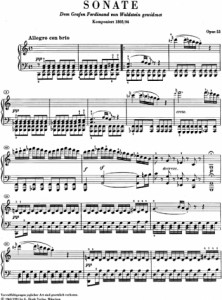 Beethoven’s Piano Sonata No. 21 in C major, Op.53, known as the “Waldstein”, is my favourite of the lot. It first came to my attention when I read Edgar Pangborn’s neglected science fiction masterpiece, A Mirror For Observers. Pangborn, a composer and pianist himself, used a performance of the piece as a key device in the plot. It remains one of the pieces I play most often.
It starts softly, with a series of rhythmic chords devoid of melody, then plays around teasingly, until the second subject, a warm E‑major melody comes in. From there, it goes through many odd modulations, twists, and mood changes, right up to the sparkling coda (it was written in 1804, right when Beethoven was busily tossing the Classical rules out the window). The short, contemplative second movement explores every ambiguous and unclassifiable emotion you can feel.
The final movement is marked allegro moderato, and poor pianists often spoil it by playing the beginning too fast. This spoils the effect of the prestissimo finale. Andras Schiff does it right. That ending sneaks up on you like a cat, and pounces. In no other sonata does the piano sound so much like an entire orchestra: passages mimic strings, horns, tympany.The arpegios aren’t cake decorations: each one is essential to the reasoning of the piece. There is every Beethoven in it: the fist-shaking Beethoven, the sweet Beethoven, the contemplative Beethoven, the trickster Beethoven. Time and again there are moments of profound beauty, including every goddam note of the coda.
I would count this sonata as one of the very greatest piano works of all time.
17015. (Luc Laeven & Fabian Valencia) IMF Working Paper: Systemic Banking Crises, A New Database [report]
This a working document issued this week by the IMF. It’s essentially an internal report by their statisticians analyzing all national liquidity crises that have occurred since 1970. There are things worth calling attention to, in it: There were 124 “systemic banking crises” spread across dozens of countries between 1970 and 2007. Almost every nation on Earth is in the list — except Canada. We’ve never had one. Read more »
17003. (Günter Hägele & Friedrich Pukelsheim) Llull’s Writings On Electoral Systems [article]

Ramon Lull, Medieval polymath from the Balaeric Islands
This important paper on medieval electoral theory doesn’t come from historians, but from mathematicians. Their interest is that the medieval Catalan scholar Ramon Lull (or Llull) (b.1232‑d.1315) anticipated the mathematical theories of electoral systems of the eighteenth century known to us through Borda and Condorcet. Apparently, recently discovered medieval manuscripts reveal that Lull had developed a quite similar theory. This interests me, of course, as the history of electoral systems is part of what I explore, but more important than the mathematical accomplishment is the implication that monastic institutions in the Middle Ages took election procedures very seriously.
17001. (Ethan B. Russo, et al.) Phytochemical and Genetic Analyses of Ancient Cannabis from Central Asia [article]
Canadian Press carried an item about the publication of this paper, which was subsequently picked up by other news agencies. The folks at CP apparently scan the Journal of Experimental Botany on a regular basis. Good on them. The discovery of a 2,700 year old marijuana stash, which 18 scientists subjected to thorough analysis, is a cheerful item of news in these gloomy times. Apparently, it was potent chronic, clearly grown for its psychotropic qualities (female only, high in THC) and accompanied by appropriate paraphernalia. Read more »
17000. [4] (Walt Whitman) Leaves of Grass: Children of Adam [verse]
If anything is sacred the human body is sacred - Whitman
In today’s prudish, prurient and bilious North American culture, Walt Whitman is as subversive as he was in the 19th century. In “I Sing the Body Electric”, probably the best poem in the Children of Adamsection of Leaves of Grass, he proclaimed his personal manifesto: look at the bodies of human beings, if you want to see the divine, the sacred, and moral truth. The ranting, perverse peddlers of phony “values” — the pulpit screechers and Conservative haters of life — know nothing of truth, beauty, or morality. There is more morality in a single line of Leaves of Grassthan in a million sermons of churchly bullshit.
(Huston 1956) Moby Dick
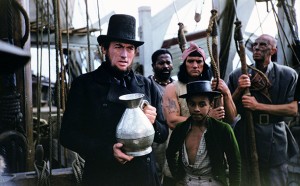 Critics were not kind to John Huston’s 1956 filming of Melville’s symbolic masterpiece, but it has much to commend it. Gregory Peck looked awkward in the role of Ahab, but in the scenes where he whips his crew into a collective frenzy (where Starbuck sees “a madman beget more madmen”) he was very effective. Ray Bradbury wrote the script, and I think it one of his most brilliant accomplishments, for it remains very true to the intentions and style of the book. Richard Basehart was fine as that simple soul, Ishmael, and Leo Genn performed brilliantly in the role of Starbuck. The special effects were superb for their time, though they might embarrass a film-maker today. Visual detail was accurate.
The world of the New Bedford whalers in the 1840s holds many surprises for a modern viewer. It was strikingly cosmopolitan — the whaling ships sailed every sea in the world, and Africans, Native Americans, Asians, Polynesians, and Europeans crewed the ships and walked the streets of New Bedford. People were genuinely, profoundly religious. Unlike the phony-balony “Christian fundamentalists” of modern America, who never actually read the bible, these people knew it by heart. Melville expected his readers to get every one of his thousands of biblical references in the novel. The movie captures both these elements exactly.