While I’ve been silenced by the demands of work, my friend Steve Muhlberger has become more voluble, with longer and more detailed blog entries, inspired by his European travels. These can be read at Muhlberger’s Early History. Among them are items on Latvia, Medieval robots, the enchanting Cornish landscape, the truth about the Cornish pastie, and a particularly fine one on the legacy of Cornish tin mines. The discussion of the distinctive pride of the miners reminded me of a medieval mining town of Kutná Hora I visited in Czech Republic. There, the gothic Church of St. Barbara (Chrám svaté Barbory) is decorated with wonderful frescoes that depict the daily life and work of miners and minters. The miners had considerable political and social power and independence, and expressed it in this extraordinary art. Read more »
Variations and Variations of Variations — Paginini’s Rabbit-like 24th Caprice
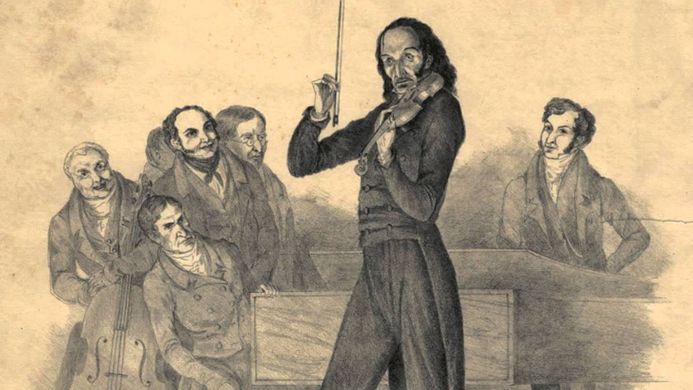 Niccolò Paganini’s 24 Caprices for solo violin, completed around 1817, are considered among the most difficult things for a violinist to master, especially the striking final caprice, in A minor. Apart from its status as the ne plus ultrashowpiece to demonstrate a violinist’s virtuosity, it’s a thumping good tune, extended into variations. Those variations have fascinated later composers, and have generated a huge number of reworkings, and fresh variations of their own device. Wikipedia lists works by 29 composers based on the last caprice. Read more »

FILMS APRIL — JUNE 2008
(Benedek 1953) The Wild One
(Nicholls 1995) Alien Empires: Hardware
(Nicholls 1995) Alien Empires: Replicators Read more »
First-time listening for June 2008
18672. (Modest Moussorgski) Boris Godunov [orch. by Rimsky-Korsakov] [opera highlights;
. . . . . d. Karajan; w. Vishnevskaya, Spiess, Maslennikov, Talvela]
18673. (Johann Sebastian Bach) Art of the Fugue, Volume 1, Groups 1–3, bwv.1080
. . . . . [orchestral version arr. by Marcel Bitsch & Claude Pascal]
(Geraint Jones, organ) Portugaliae Musica, vol. 4 — Musique Portugaise pour orgue:
. . . . 18674. (Antonio Carreira) Fantasie
. . . . 18675. (Manuel Rodrigues Coelho) Five Versets on Ave Maris Stella
. . . . 18676. (Carlos Seixas) Fugue in A Minor
Read more »
READING – JUNE 2008
16271. (George Woodcock) Gabriel Dumont
16272. (Shashi Tharoor) The Elephant, the Tiger, and the Cell Phone ― Reflections on India,
. . . . . the Emerging 21st-Century Power
16273. (Richard van Emden) Boy Soldiers of the Great War Read more »
16305. (Giles Milton) White Gold ― The Extraordinary story of Thomas Pellew and North Africa’s One Million European Slaves
One of the more annoying bits of nonsense that crops up is the notion that there are forms of chattel slavery which are somehow benign. It is often claimed that “traditional” slavery in the Islamic world was somehow less of an abomination than the slavery in the American South or the Caribbean. Classical historians often promote a similar Gone With the Wind-ish interpretation of slavery in ancient Rome, always concentrating on the less numerous domestic servants while ignoring the millions who were worked to death in the mines, on plantations, or by the urban syndicates that owned the water-carriers.
Those who are inclined to accept this constantly resurfacing fantasy are encouraged to read this book. It’s an account of the life of Thomas Pellew, a Cornish child captured by slave-raiders in 1716. He became a slave of the Morocan sultan Moulay Ismail (whose descendant still rules Morocco today. In the 17th and 18th centuries, slave traders from the Moroccan port of Salé terrorized the Cornish coast, often raiding villages and seizing hundreds of men, women and children to sell in the lucrative slave markets of North Africa. It is estimated the roughly a million Europeans, Americans and Newfoundlanders were captured in this way, during that period. British monarchs dealt with these assaults with a combination of bluster, misdirection, double-dealing, self-interested hypocrisy, fake sabre-rattling, bribery, alliances with their own enemies, and overwhelming cowardice that was virtually identical to the Bush administration’s response to 9/11. Themselves active in a colossal slave trade, European Christian aristocrats and wealthy “entrepreneurs” were happy to collude with their Muslim counterparts.
In Thomas Pellew, who spent a great part of his life as a slave in a particularly good position to form an overall evaluation of slavery in North Africa, and who escaped to tell the tale, we have plenty of testimony to the brutality of slavery in North Africa. Even Pellew, who survived as a “privileged” personal slave, suffered unspeakable tortures, beginning at the age of eleven. The bulk of the captives were abused, tortured, and quickly worked to death in massive construction projects, or laboured in chains in the fields. There was no “benign” slavery, because there has never been any form of slavery that was benign, anywhere. Slavery is slavery, always filthy, evil and disgusting, at any time, in any place, in any culture.
Giles Milton’s book, taken largely from Pellew’s account, but well corroborated and researched, is well-written.
Sibelius: En Saga
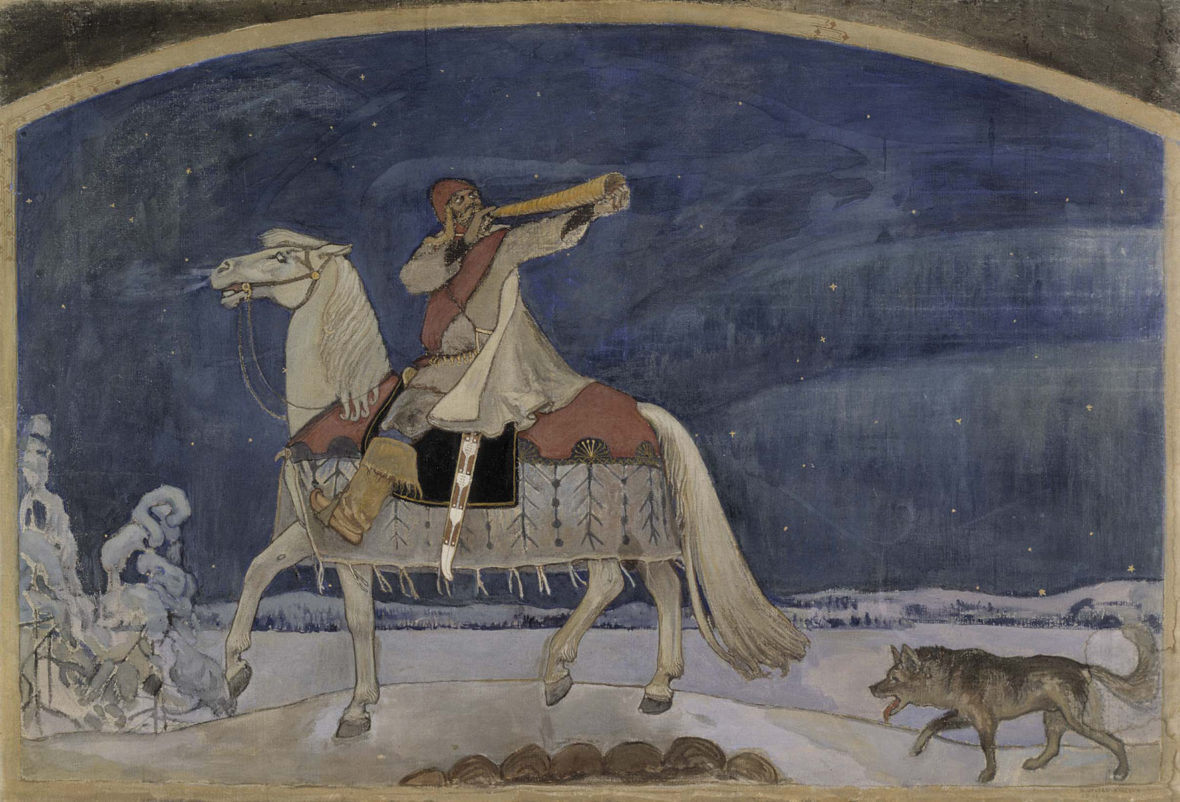
Throughout my life, Sibelius has remained unchallenged as my favourite composer. As much as I might love Mozart, or Dvorak, or Vaughan Williams, and take delight in even their minor compositions, none has the place in my heart, and subconscious, that Sibelius has. The first work of the granite Finn that I ever heard was En Saga, Op.9. It has usually been considered no more than a rousing showpiece, but I think it offers some depths to explore. Read more »
(Bay 1998) Armageddon
Oh My Gawd what a horrible film! Oil riggers equipped with no skill or knowledge save the earth from asteroid impact by flying to the asteroid in the Space Shuttle and drilling a hole a mere 800 feet into it (as if this would make a difference?), to plant a nuclear bomb . They and NASA and various military types save the Earth by competing in how loudly they can shout at each other and who can say the toughest things. A soppy romance is thrown in — one that makes you cringe whenever those characters show their faces. Annoying acting, annoying music, annoying everything, and scientific illiteracy so profound that NASA uses the film to train astronauts. They are required to identify as many of the 167 major violations of physical laws and probabilities as they can. Yes, 167.
Mozart: Symphony #1 in E‑flat, K.16
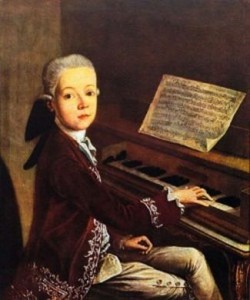 Mozart composed his first symphony at the age of eight, and what’s remarkable is not only that it is a perfectly competent work, which could be played to good effect at any concert, but that it already shows many distinctly Mozartian features. It already has the sense of playful invention, of twisty-turny, peekaboo surprise that Mozart preserved in even his most serious works until the end of his life. It was composed on a visit to London, and it shows the distinct influence of Johann Christian Bach, who was also in London at the time. Influence, not mere copying, all the more remarkable because it was only his sixteenth work. It is not, as some assumed, the work of Mozart’s controlling and ambitious father, Leopold, passed off as the boy’s. While this seven minute symphony is no masterpiece, it’s impossible to listen to it without wondering how the hell this stuff could be in the mind of an eight-year-old.