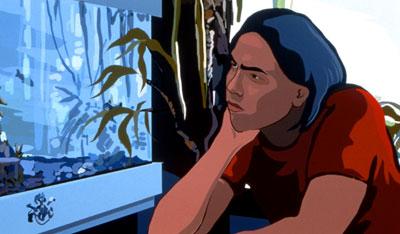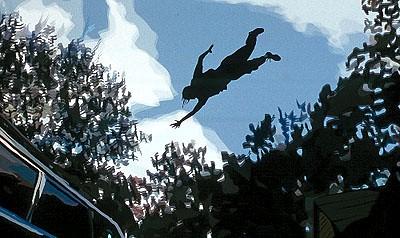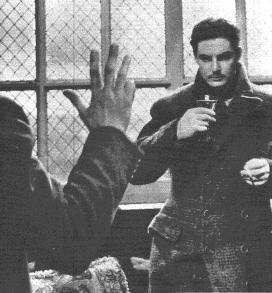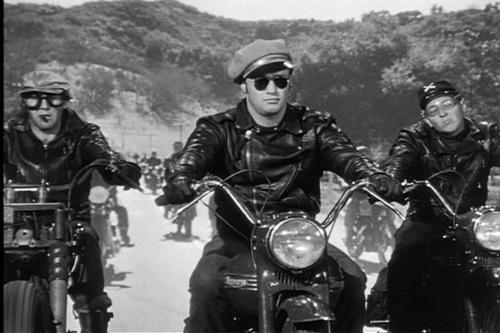
Finally got around to seeing this, albeit only on the small screen. I never knew there could be anything more tedious than Parsifal. I notice now that the female characters in the Star Wars movies have gotten progressively more inactive and ornamental. Remember Princess Leah? She was expected to do some fighting and solve problems. But that was the 1970s. This episode’s Padmé has all the dynamism of a hydrogen atom at the end of the universe. Not even spectacular CG battles could keep my eye on the screen. I’m not very demanding when it comes to space opera. A few nice visuals, maybe a clever line or two is all it takes to keep me happy. But I would have been pissed off if I had paid theatre prices to see this.
Category Archives: D - VIEWING - Page 25
(Lucas 2005) Star Wars: Episode III ― Revenge of the Sith
(Levin 1959) Journey to the Center of the Earth

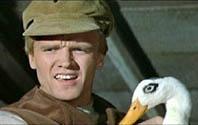
Giant Icelander Peter Ronson, and Gertrude the Eiderduck, the real stars of Journey to the Center of the Earth
I’m very fond of this absurd 1950s Hollywood version of the Jules Verne classic. My brother tells me that my childhood fascination with paleontology can be traced to being terrified by the “dinosaurs” of the film ― small garden lizards with rubber fins glued to them, matted into the film. Believe it or not, this was top-of-the-line special effects when the film was made, the only other option being claymation. Other unintentionally humorous elements of the film include the casting of Pat Boone (yes, Pat Boone!) as a young geology student spouting the most pathetic attempt at a Scottish accent in history, and a scene where the adventurers reach “a place with a magnetic field that snatches gold away, the junction of the north and south magnetic fields, the CENTER OF THE EARTH!”, which appears to be a whirlpool in an underground ocean. The conceptual confusion in the scene transcends anything you have ever seen in any other movie. Even Ed Wood had a better grasp of physics. Jules Verne’s novel is quaint, today, but it fit reasonably well into the science of its time. Somehow, the screenwriters managed to push the film’s scientific understanding to about two thousand years earlier than Verne.
James Mason and Arlene Dahl are the lead actors in the film. It had a big budget, a lush score composed by Bernard Hermann, and was partly filmed in Carlsbad Caverns, though that natural wonder appears to be filled with cheap junk jewelery and papier maché boulders. Mason does a wonderful job of keeping a straight face as they encounter dinosaurs, giant mushrooms, and the lost city of Atlantis. A villain follows them, played by Thayer David, and he gets to utter one of the most wonderful bad lines in film history: “I never sleep… I hate those little slices of death.” But despite all that high-powered haminess, the film is stolen by Peter Ronson, an Icelandic olympic athlete who got the part because he was the only Icelandic-speaking giant, muscular man available in Hollywood. His character, Hans, seems to have an unhealthy passion for a pet eiderduck, and the duck accompanies them to the center of the earth, meeting a tragic end when the villain gets hungry. Hans’ remorseless march of vengeance is the most wonderful part of the film. Peter Ronson died, last year. This was his only appearance in a film.
FILMS OCTOBER-DECEMBER 2007
(Mehta 2002) Bollywood / Hollywood
(Krishna 1991) Masala
(Brock 1984) The Living Planet: Ep.1 The Building of–― the Earth
(Cohen 2005) Stealth
(Collet-Serra 2005) House of Wax
(Dong 2004) Licensed to Kill
(Brock 1984) The Living Planet: Ep.2 The Frozen World
(Bristow 2004) Jane Goodall’s Return to Gombe
Read more »
(Weitz 2007) The Golden Compass
My friend Isaac White magically came up with tickets to a preview showing of The Golden Compass, and we were both pleasantly surprised. We both knew Pullman’s superb novel for kids, and did not have high hopes that it would translate well into a movie. But we ended up quite satisfied with the results. Of course, changes were inevitable, because what works in prose often doesn’t work in film. In order to preserve the rather complex plot, the pace had to be quickened. The book has leisurely paced segments punctuated by occasional bursts of action. By necessity, the film compresses everything so that the action sequences dominate. But the important thing is that it preserves the integrity of the book.
And integrity is the right word. I’m talking about this on my blog page, because the film is already under vicious attack from all the forces of barbarism. The book is a profoundly moral one, with a sense of outrage at injustice, that urges its young readers to question authority, think for themselves, and rebel against tyranny. It has come along just when it is needed. The film preserves much of this moral strength. So it’s no surprise that the marching morons are out in force. I have read of numerous cases where schools are posting signs warning their students against seeing the movie, and there are boycotts being organized by various authorities who, apparently, have no trouble identifying themselves as the intolerant Magisterium of the film’s fantasy story.
Conformity, cowardice, ignorance, and groveling before authority are the prescribed cultural norms of the last thirty years, in both the United States and Canada. A whole generation has been raised in a kind of cesspool of Conservative immorality. That is the only word for it. Organized religion and government have combined forces to destroy the very idea of morality, which depends on the functioning of the independent, autonomous, reasoning individual mind, and substitute its own false gods: Superstition, and Blind Obedience. The Conservative ideal is always a world without morality, and without reason.
This film will, perhaps, offer a tonic, a bit of inspiration for children raised in the bleak amorality of a Conservative culture. Its symbolism is easy for any bright child to absorb. The “golden compass” of the story is a gadget, but it is clearly meant to symbolize the moral compass — the individual commitment to reason and justice that allows a human being to distinguish right from wrong, freedom from slavery, truth from lies, and honour from dishonour. People without a moral compass do what they’re told. They torture prisoners in Guantanamo when told to, they let meddling bigots manage their sex lives, they accept rigged elections, they don’t talk back to Those In Charge. They become amoral zombies, and that is what powerful religious organizations and governments have generally preferred human beings to be.
Historically, young people have usually found their moral compass through art. My understanding (and hatred of) slavery was first learned by reading Huckleberry Finn, as a child. It is invariably the books that touch on significant moral questions, that encourage the young to question authority and think for themselves that attract the attention of the censorious. Usually the reasons proffered to justify the attacks are spurious, whatever sounds most plausible at the moment, because the underlying reason is too ignoble to make plain.
(Wu 2000) Yingxiong Zheng Chengong [Hero Zheng Chengong / or / Sino-Dutch War 1661]
Taiwan is an island which was originally populated by Malayo-Polynesian peoples. Over a period of about five hundred years, it absorbed settlers from the Chinese mainland, mainly from the province of Fujian. The aboriginal peoples where displaced and absorbed, and only two percent of Taiwan’s population are now identified in this group. The bulk of the population speak a variety of Min Chinese somewhat similar to that of Fujian. However, Mandarin is the official language, taught in the schools, and necessary for all official and business purposes. The Dutch controlled the island between 1624 and 1662. Zheng Chenggong [鄭成功], or more correctly Koxinga [國 姓爺] was a Ming loyalist who defeated the Dutch. He’s been adopted as a hero by both the Beijing regime,to whom he represents Chinese rule over Taiwan, and by Taiwanese nationalists, for whom his rear-guard action against the Qing represents a parallel with Chiang’s Kai-shek. When Chiang’s Kuomintang Party was defeated in 1949–50, he and his followers retreated to Taiwan, which had only recently been liberated from Japan. Curiously, the Japanese rulers of Taiwan also considered Zheng a hero, because his mother was Japanese! Everyone seems to want a slice of Zheng. Any movie about him is, ipso-facto, bound to be politically motivated. Read more »
(Hitchcock 1953) I Confess

If you’re looking for a good Hitchcock film that isn’t constantly screened, then check out this 1953 item which failed at the box-office, but contains all the elements of classic Hitchcock. Montgomery Clift gives one of his typically tense and repressed performances as a priest falsely accused of a murder. The setting, Quebec City in the early 1950’s, is represented with more realism than Hollywood usually managed with such “exotic” locales at that time. The main hook, that the priest can’t clear himself because the real murderer has confessed to him under the “seal of the confessional”, might be a stumbling block for today’s audience, but given that understanding, the plot works out logically. The heroine, played by Anne Baxter, comes across as a thoroughly dislikable person, which may have been the main reason the film failed with the public. By the end of the first reel, I was hoping that she would turn out to be the real murderer. Karl Malden gives an odd performance, obviously uncertain how to represent a French Canadian police detective, and uncomfortable with his stilted dialog.
(Krishna 1991) Masala; (Mehta 2002) Bollywood / Hollywood
Both these films, made eleven years apart, are surrealistic comedies about Indo-Canadian families in Toronto. I first saw Masala with a roomful of friends, some of South Asian background, some not, but all Canadians raised in Toronto. I think we all enjoyed it more for its “Toronto-ness” than for anything as dourly serious as “identity politics”. It had the feel of our city, and the same goofiness that you would see in Strange Brew. Seeing the venerable Saeed Jaffrey as the God Krishna in a Leaf’s goalie uniform had us rolling on the floor with laughter. And the same actor portrays the long-suffering postal clerk, to whom Lord Krishna delivers the rarest Canadian stamp, but who is unwilling to sell it either to satisfy his wife’s craving for appliances, or the government’s pressure, and is the Canadian Everyman in a nutshell. Read more »
FILMS JULY-SEPTEMBER 2007
(McKellar 1998) Last Night
(Arbuckle 1917) The Butcher Boy [w. Roscoe Arbuckle & Buster Keaton]
(Arbuckle 1917) The Rough House [w. Roscoe Arbuckle & Buster Keaton]
(Arbuckle 1917) His Wedding Night [w. Roscoe Arbuckle & Buster Keaton]
(Arbuckle 1917) Oh, Doctor! [w. w. Roscoe Arbuckle & Buster Keaton]
(Godwin 1999) Wonders of the African World: The Road to Timbuktu
(Appio 1999) Wonders of the African World: Lost Citis of the South
(Hathaway 1953) Niagara Read more »
(Morris 2004) The Fog of War: Eleven Lessons from the Life of Robert S. MacNamara
I strongly recommend this film. It’s probably the best of the political documentaries circulating today. Since newspapers, radio and television have stopped being of any use to anyone who wants to learn things about politics, documentary films have emerged as the most effective medium for discussing public affairs.
For those who are too young to recognize the name, Robert Strange McNamara was one of the pioneers of strategic systems analysis during WWII, and served as Secretary of Defense for Kennedy and Johnson from 1961 to 1968. He then became President of the World Bank until his retirement in 1981. What is now called “policy analysis” is an amplification of the “systems analysis” that he introduced to the Pentagon. Understanding McNamara’s background, psychology and motives is essential for any attempt to evaluate American foreign policy during the 1960s. Read more »
(Englund 1963) The Ugly American
This fascinating film, based on the best-selling 1958 novel by Eugene Burdick, and filmed in the traumatic year of 1963, contains one of Marlin Brando’s best performances. Brando was at the height of his powers, and instinctively knew how to act with his body, making every gesture, every slump of a shoulder or crease of a brow advance the story.
The film is also fascinating from a political point of view. Americans were just starting to experience a series of embarrassing setbacks in foreign policy. They were committed to an immoral and astonishingly stupid policy of supporting dictators and betraying underdogs. Every intelligent and humane person in the U.S. knew this. However, the analysis of the policy’s opponents suffered from some serious flaws. The orthodoxy among critics of American foreign policy was that people like Fidel Castro were merely patriotic national leaders who were being “driven into the arms” of the Soviet Union by the foolish hostility of the White House. This idea was pure nonsense. Castro, and other like him, were clients of the Soviet Union from the start, and tyrants from day one. Their adherence to the Soviet Empire was automatic, and driven by the fundamental evil of their natures. Clever foreign policy might have bought them off, or better yet, allowed their local victims to overthrow them. However, the U.S. State Department did not employ anyone with either brains or principles. Every infantile and corrupt “strategic” step they took, usually justified with smarmy platitudes about “realism”, merely played into the hands of the Soviets and entrenched the soviet clients in power.
In other words, both the proponents and the critics of U.S. foreign policy, at the time, didn”t know what the hell they were talking about. Not surprisingly, shortly after the release of this movie, America began its disastrous war in Vietnam.